Way to go on your cell models!!


Checking out your cell models was so fun! I could see the time investment you made into them - time well-spent learning about the organelles and functions. I hope you still had time to do the wk 6 readings and videos. They cover the cell membrane, concentration gradients, diffusion, osmosis, and active vs passive transport. Those ideas are built upon in wk 7 when we read about photosynthesis (which requires lots of movement back and forth across membranes). But before wk 7, here's a great little video that shows a number of organelles and how they work to fight a viral infection.
Looking ahead to wk 7
Remember how we classified all organisms as either prokaryotes or eukaryotes? We classified them based on the whether or not they had a true nucleus and membrane-bound organelles - their cellular structures. We can also classify organisms in another way - how they get energy. All organisms can be defined as either autotrophs or heterotrophs.
- Autotrophs produce organic molecules (like carbohydrates) from simple inorganic substances (like carbon dioxide and water) by harnessing light energy* from the sun. The organic molecules they produce contain stored energy in their molecular bonds, which can be used to carry out all life processes. All plants are autotrophs, algae are also autotrophs. (*chemostrophs, which use oxidation of substances in the environment for energy, can also be autotrophs, but we will focus autotrophs which use photosynthesis).
- Heterotrophs cannot make their own organic molecules from inorganic substances, and so they must consume organic molecules from another source (like eating an autotroph or another heterotroph). All animals, including humans, are heterotrophs. Fungi, some protists, and many bacteria are heterotrophs, too.

Photosynthesis, the process upon which (almost*) all living things depend for the energy they need to live. The process seems magic - turn light into stored energy we can can use whenever we need. It also gives us the oxygen we need to breathe, so if you like to breathe thank a plant. Scientists have studied the intricacies of photosynthesis, and we actually know a lot about it. In fact, as you read you might feel a little overwhelmed with just how much we know about it. Here are the key concepts to understand:
- Photosynthesis can be summarized as a chemical reaction of carbon dioxide, water, and light energy to produce glucose (sugar), and oxygen. Know this:

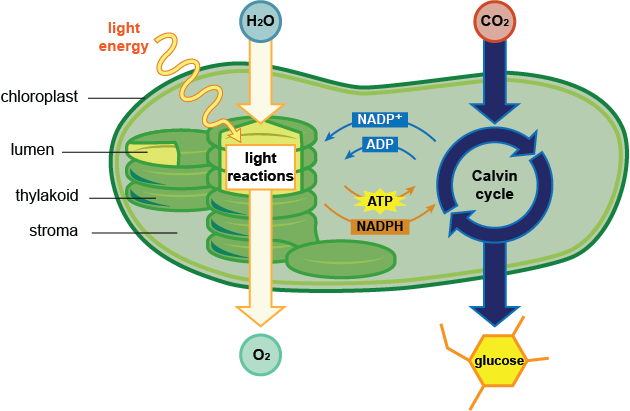
- The process of photosynthesis involves many reactions, certain high energy molecules (NADPH and ATP), and special protein complexes not reflected in the summary formula above. Transition students should be familiar with this, and scholar students should know this:

- there are light-dependent reactions (use light energy from the sun), or simply light reactions - these occur in the lumen and thylakoid membrane of the chloroplast, and use light energy, ADP, and NADP+ to split water and make oxygen, ATP, and NADPH.
- there are light-independent reactions (don't need light energy) which together are called the Calvin cycle or dark reactions - these occur in the stroma, and use carbon dioxide, ATP, and NADPH for carbon fixation, creating glucose, as well as NADP+ and ADP which are recycled back to the light reactions.
What if we could make something to harness the energy of the sun, just as plants do, but instead of building sugar molecules we built other complex carbon molecules that could be used as a fossil fuel alternative, or harness it directly into electrical energy? There are scientists and engineers out there tackling these questions today.
Is there a way to create organic molecules in photosynthesis without using water? Answering this question may help our search for life on other planets, or make it possible to colonize Mars, which has almost no available water and an enormous amount of carbon dioxide (95% of the atmosphere is CO2). As we continue to observe, study, and test the natural world around us we will be better able to improve lives and solve problems.
Readings and Other Resources
7 Heterotrophs and
autotrophs, photosynthesis
|
RSO Ch. 6 Cell Energy
|
LOE ch 8 Intro-8.1
|
CK12 BC 2.18-2.23
|
CK12 LSC 2.11-2.12
|
Heterotroph
vs Autotroph - All, basic explanation of what heterotrophs and autotrophs
are, and an introduction to photosynthesis
Photosynthesis and Pigments - Transition, Amoeba Sisters teach us about pigments in the chloroplasts, and photosynthesis light reactions and Calvin cycle
Leaves
and Light - Scholar, a video that talks about the structure of the
chloroplasts and how chlorophyll absorbs and reflects certain wavelengths
(colors) of light
Photosynthesis
Steps and Pathways - All, this video covers both the light reactions and
the Calvin cycle in general (Scholars, this is a warm-up for the video
below)
Photosynthesis - Scholar, this virtual
cell video shows both the light reactions and the Calvin cycle of
photosynthesis in detail. You don't need to know all the details, but
sometimes studying one level deeper helps you better understand the level you
are working at
Photosynthesis Diagrams Worksheet - Scholar, you might want to use these diagrams to help you understand as you read about the different reactions in photosynthesis
|
Keep working on your vocabulary lists.
A heads up that our first full lab write-up will be about the cellular respiration experiment we will do on NOV 5. You will get a pre-lab information sheet this week, and the write-up will be due one week after the experiment, NOV 12.

No comments:
Post a Comment
Note: Only a member of this blog may post a comment.