Friday, September 25, 2015

Wk 2 recap, looking at Wk3

We covered four topics in lab this week - Powers of Ten/Scale, Microscope Operation, Characteristics of Life, and Lab Safety.


Powers of Ten/Scale  

In science we study everything from the vast universe to subatomic particles.  If we only spoke about these things in meters, liters, and seconds we would have to write things like "the known universe is about 8,800,000,000,000,000,000,000,000 m wide" and "the diameter of a hydrogen nucleus is about 0.000000000000000175 m."  Keeping track of all those zeros alone is difficult, but doing math with them is tedious, unless you use scientific notation (powers of ten)!  We can say that the universe is 8.8 x 10^26 m wide, and the diameter of a hydrogen atom is 1.75 x 10^-15 m.   We also assign prefixes to some of the powers of ten, for example 10^3 m (1000 m) is called a kilometer (km). If you still feel you need more to understand the scale of these little things we study in biology I recommend this Khan Academy video.

Because I know you are all so excited to find out the answers to the Matching Scale quizzes, I will give you the answers. If you haven't tried a quiz, give it a shot: transition level here, scholar level here.

Transition level answers:

1-j, 2-o, 3-h, 4-a, 5-d, 6-e, 7-k, 8-g, 9-m, 10-b, 11-i, 12-c, 13-f, 14-n, 15-p, 16-l

Scholar level answers:

1-x, 2-q, 3-w, 4-j, 5-f, 6-bb, 7-c OR z, 8-z OR c, 9-i, 10-g, 11-d, 12-k, 13-r, 14-s, 15-a OR y, 16-y OR a, 17-e, 18-o, 19-v, 20-m, 21-h, 22-t, 23-l, 24-b, 25-n, 26-p, 27-aa, 28-cc, 29-u
*my apologies - there was a mistake in the Size and Meters columns for number 24 - it should read 10 Giga-meters and 10,000,000,000 m respectively.


Microscope Operation


We will be doing many microscope investigations/labs this year.  Please make sure you are familiar with the parts of the microscopes and are confident in using them.  You can go back and do the interactive tutorial again if needed.


Characteristics of Life


We got to observe some wriggling earth worms and look for evidence of life.  Some characteristics noted were movement/responding to environment, homeostasis, and using energy/metabolism (they are so transparent we could see food in their guts!).  Please see last week's readings and web content to learn about the characteristics of life if you haven't already.


Lab Safety


We discussed lab safety issues and I asked everyone to sign a safety contract.  I need to know you are committed to being safe in the lab in order for you to participate.  I will bring next week the safety contracts to sign for the few who forgot to yesterday. 


Looking Ahead to Week 3


Week 3's topics are Cell Theory and Prokaryotes vs Eukaryotes.  The Cell Theory has three main parts: 1) all living things are composed of one or more cells, 2) cells are the fundamental unit of life, and 3) cells rise from other pre-existing cells in a process called biogenesis.  All cells are either Prokaryotic or Eukaryotic.  Please read up on these topics from your chosen text.  If you are reading from the CK12 Biology Concepts (the scholar level CK12 text) this week's reading is short, so you may want to get a jump on next week's reading, which is longer.  After reading (and taking notes, which I highly recommend - if you don't know where to start with this you can try using Corenll Note system or I would be happy to talk to you one-on-one about other note systems for studying scientific writing and texts), watch the online videos.  Reviewing notes the next day, and then again in a week's time do much to solidify the concepts in your mind.

Week 3's lab will include slide preparation, slide staining, and making measurement estimates with the microscope.  We will also introduce the Science Vocabulary challenge...

Week
RSO
LOE
CK12 BC
CK12 LSC
Other Resources


3 Cell Theory, prokaryotes vs eukaryotes, wet mount slide preparation


*Science Vocabulary Challenge introduced in class
Ch. 2 Cell Types
Ch 5 Intro
Ch 5.1
Ch 5.2
1.5
2.2 (2.3)
2.1
2.2
Weird History of the CellTheory transition (but funny, scholars may enjoy it anyway)

Cell Theory scholar

Prokaryote vs Eukaryote scholar web video lecture or there's also this one


4 Components of a cell, cellular specialization, plant vs animal cells, stained slide

*Project 1 "Cell Model"
Ch. 3 Inside Story
Ch 5.2
Ch 5.3
(Ch 5.4)
Ch 5 Review
2.1
2.4
2.5
2.6
2.7
2.8
2.9
2.10
2.11
2.3
2.4
2.5
2.6
Cells Alive look closer at the differences between plant and animal cells

Crash Course - Eukaryopolis scholar These Crash Course videos move fast and contain a lot. You might watch them before reading, but you will get the most out of them by watching after you have read.


RSO=Real Science Odyssey Bio 2, LOE=Life on Earth, CK12 BC= Biology Concepts, CK12 LSC=Life Science Concepts


Friday, September 18, 2015

Week 1

First, I wanted to share how impressed I was with things I saw in class - good thinking, good questions, good notes, careful observations - these are all good scientific habits of mind!

This week's class was about science as a process.  Many times we think science is a bunch of facts and equations - a huge bank of information, but in reality, science is a process used to understand and explain the world around us.  We call it The Scientific Method
We spent some time in the "field" making observations of a plot.  We didn't get very far, and really that was the point.  Science is a process that takes time, diligent effort, and sufficient information to make it viable.  I recommend following up and reading this page - if you can read and understand it then you know you've got a good grasp on what science is and the process it uses.


For next week, please read the section(s) in your text and do the microscope tutorial linked under Other Resources in the week 2 schedule.  All the links under Other Resources are valuable.  Our Week 2 Lab will focus on characteristics of life, use of the microscope, and powers of 10 related to magnification, scale, and scientific notation.

Here are those Other Resources (I added a few to help clarify things) for Week 2:


Microscope Tutorial *completing this beforehand will make our lab run much smoother*

Powers of Ten this foundation will help in understanding measurements, scale, magnification, and scientific notation

Negative Powers of Ten this will also help with measurements, scale, magnification, and scientific notation

More Powers of Ten this video gives you a visual idea of scale in powers of ten, from galaxies to the nucleus of an atom

Scientific Notation this is a brief explanation of scientific notation (something you really need to know in order to do scholar level science).  If you are working at a scholar level and this math is unfamiliar to you I recommend studying up on it - here are some instructional videos on the topic Basics, Add/Sub, Mult/Div (these are Advanced videos).  We won't use significant figures in our calculations, but that is also a very important math concept to know for science.

Cells alive looking at magnification powers of a microscope

Characteristics of Life (first 7:30 of the video) Some people categorize these characteristics differently (e.g. one might say taking in nutrients and giving off waste are two different characteristics while another might categorize them both under the one characteristic of metablolism) but how they define life is still the same.

Saturday, September 5, 2015

Schedule Weeks 1-4

Here are the first four weeks of topics with readings and web content.  The material in each week should be studied before class in order for you to best understand our lab activities.  That means the material in Week 1 should be covered before the first day of co-op on the 17th.


Week
RSO
LOE
CK12 BC
CK12 LSC
Other Resources
1 What is science, the scientific process, and why biology?

Ch 1 Intro
Ch 1.3
(Ch 1.4)
1.1
1.2
1.3
1.1 (1.2)
1.4 (1.3, 1.5)


2 Characteristics of life, microscopes as a tool to study life, powers of 10
Ch. 1 Living Things
Ch 1.1
Ch 1.2 (esp chart on page 17)
Ch 1 Review
1.4
1.6
1.8
Microscope Tutorial *completing this beforehand will make our lab run much smoother*

Powers of Ten this makes understanding magnifications a little clearer

More Powers of Ten this video gives you a visual idea of scale in powers of ten

Cells alive looking at magnification powers
3 Cell Theory, prokaryotes vs eukaryotes, wet mount slide preparation
Ch. 2 Cell Types
Ch 5 Intro
Ch 5.1
Ch 5.2
1.5
2.2 (2.3)
2.1
2.2
Cells Alive comparing prokaryotes and eukaryotes


4 Components of a cell, cellular specialization, plant vs animal cells, stained slide

*Project 1 "Cell Model"
Ch. 3 Inside Story
Ch 5.2
Ch 5.3
(Ch 5.4)
Ch 5 Review
2.1
2.4
2.5
2.6
2.7
2.8
2.9
2.10
2.11
2.3
2.4
2.5
2.6
Cells Alive look closer at the differences between plant and animal cells

Crash Course - Eukaryopolis lvl 2 These Crash Course videos move fast and contain a lot. You might watch them before reading, but you will get the most out of them by watching after you have read.


RSO=Real Science Odyssey Bio 2, LOE=Life on Earth, CK12 BC= Biology Concepts, CK12 LSC=Life Science Concepts

Friday, September 4, 2015

Choose your own adventure (book)

This year you will have the opportunity to delve into the study of biology!  Our once a week class will be far too short to cover the breadth of general biology in its entirety.  Instead, each week we will focus on inquiry into a topic through labs, simulations, and other activities.  The things we do in class will have greater meaning and give you better context if you have been studying about biology on your own.  I have prepared a reading schedule and internet links to coincide with our weekly labs.  You may use any text you prefer, but I have already outlined the corresponding reading for 3 free texts as well as the Real Science Odyssey Biology 2 text.  The outlined texts are:

Life on Earth - this is a scholar level text for introductory biology, written by one of our greatest contemporary biologists and a pioneer in the field of ecology, E. O. Wilson.  The text is available as an iBook download, and includes embedded videos, interactives, quizzes, and other components.

CK12 Biology Concepts - this is also a scholar level text for introductory biology, and includes embedded videos, interactives, and other components.  This is web-based, and is free to access online at the CK12 website.  You can also download a non-interactive PDF version of the pages.

CK12 Life Science Concepts - this is a transition level text for life sciences, and includes embedded videos, interactive, and other components.  This is web-based, and is free to access online at the CK12 website.  You can also download a non-interactive PDF version of the pages.

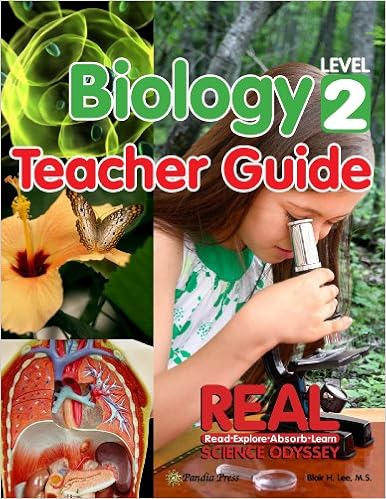
RSO Biology 2 - this is a transition level text for Biology.  It is written mainly for homeschool use and does include some internet links.  It is for purchase either as a PDF file or as a printed text.  There is both a student and a teacher's edition.  This text includes readings, labs, microscope labs, activities, mini research projects, and review quizzes.  The teacher's edition has answers as well as tests.  See their store for prices and a "try before you buy" sample.  These products are currently on sale for 25% off (through the end of Sep 2015, see this page for details).

The schedule will have relevant readings in all four texts, along with additional web content I believe helpful, noteworthy, or just plain fun relating to the weekly topic. You can choose one text to study this year, or you can text hop between them all.

And stay tuned for information on Biology literature for optional colloquia.