Monday, December 7, 2015

Wk 11, Looking Ahead to wk 12

Meiosis

I hope you all did the readings and watched the videos last week on meiosis.  It probably seemed very familiar, since it is similar to mitosis.  It is important not to mix these two processes up though! The key things to remember:

  • Mitosis is for making exact copies of cells, and Meiosis is for making unique sex cells (each with half the chromosomes of a normal body cell).
  • A normal body cell in humans has 46 chromosomes, 23 from mom and 23 from dad, and we call this condition diploid and represent it with the symbol 2n.
  • A sex cell, also called a gamete, has 23 chromosomes, and we call this condition haploid and represent it with the symbol n.
  • When a male gamete fuses with a female gamete you get a single new cell with 46 chromosomes, which is diploid, and called a zygote.
  • During meiosis, when sister chromatids line up with each other they can swap genetic information in a process known as  crossing over.


Bioethics

We began a discussion on bioethics in class this week.  After learning about some interesting issues in genetics, from mutations to pet cloning to cybernetic roses, we posed the question, "When is it ethical to alter genetic information?"  There was some good discussion and ideas, and we will be coming back to this question again several times.

Readings and Other Resources

Don't forget to do the readings! And work on vocabulary!
12 Genetics, Inheritance


*Second Mini Project assigned -
Qwotekutesnute*
Ch. 10 Your Inheritance
Ch 11 Intro-Review
CK12 BC 3.1-3.15
CK12 LSC 3.8-3.14
Gregor Mendel - both, Teacher's Pet video on the father of genetic study

Monohybrids and the Punnett Square - both, Amoeba Sisters explain alleles, monohybrid crosses, and the Punnett square

Dihybrid Crosses - scholar, this is also Amoeba Sisters but teaches a slightly more complex Punnett square for two traits.

Sex-linked Traits  - scholar, the genetics of sex-linked genes and how to put them in a Punnett square

Multiple Alleles - scholar, sometimes there are more than just dominant and receive alleles for  a trait and here is how that works


Saturday, November 28, 2015

wk10, looking ahead to wk11

The Cell Cycle


In week 10 we discussed the phases of the Cell Cycle, and spent extra time on cell division, including mitosis.

First in the Cell Cycle our cells grow (G1 phase).  Then they replicate their DNA (S phase).  Then they grow some more, do checks for accuracy, and get ready for mitosis (G2 phase). These three phases together are known as interphase.
Once the cells are done with interphase they enter M phase, also known as cell division.


Ok, so we aren't really doing mathematical division.  It is actually more like multiplication, since we start with one and end up with two.  
Cell division is comprised of two parts - mitosis and cytokinesis. Mitosis is itself comprised of four phases - remember PMAT? Prophase, Metaphase, Anaphase, and Telophase.  Each step is important for orderly production of two identical daughter cells.

Looking Ahead to wk11


Cell division using mitosis is important to create additional somatic (body) cells for growth, or for replacement if the cell is damaged or destroyed. All of this happens within the same organisms.  Some organisms use very similar processes to create duplicate organisms. Examples of this are budding and binary fission. Binary fission is the common mode of reproduction in bacteria - each bacteria (made up of a single cell, but still a distinct organisms) makes a duplicate of itself to create additional bacterial organisms. These types of reproduction, where the new organism is an exact genetic copy of the parent organism, are called asexual reproduction.

Humans and a great many other complex organisms, use a different method of reproduction known as sexual reproduction, where two incomplete sets of DNA from two parent organisms combine to make a genetically unique offspring. In order to produce the needed special cells (called sex cells or gametes), which have only half of the genetic information (haploid), there is a similar but different process to mitosis and it's called meiosis.

So why go through this extra effort of creating cells that have half the genetic information (haploid) just to combine them with another haploid cell from a new organism with complete genetic information (diploid)? Why not just use asexual reproduction like starfish and bacteria and make little clones of ourselves instead? There are several reasons, but the big one is this: genetic variation.    We will take more about genetic variation in wk12 and when we discuss evolution, but for now know that genetic variation is what gives individual organisms of the same species variety - say in birds different feather coloring, different beak shape, different body size, different songs, etc.  It is this variety that allows the species as a whole to adapt to the environment.

Here are the readings and videos/resources for this week.  Don't forget to keep working on your vocabulary.


11 Sexual vs Asexual reproduction, ploidy, meiosis
RSO Ch. 9 Meiosis Divides by Two and Makes You
LOE Ch 12 Intro-Review
CK12 BC 2.36-2.40
CK12 LSC 2.20-2.22
Chromosome Numbers in Mitosis - transition, Amoeba sisters cover the number of chromosomes at different stages in mitosis and meiosis

Meiosis The Great Divide - transition, Amoeba sisters do an overview of meiosis and gamete formation

Meisosis Square Dance - both, Ok, this is funny! But it can also be a good way to remember the phases of meiosis, and what happens at each.  You can use this worksheet that has the lyrics and  questions to clarify the steps

Sexual vs Asexual Reproduction - both, this is an interactive to quiz your understanding of what organisms use sexual reproduction, asexual reproduction, or both.

Meiosis - scholar, Crash Course covering meiosis and the production of gamete cells


Tuesday, November 17, 2015

wk9, looking ahead to wk10

First off, my apologies to you that I wasn't able to be in class last week.  But thanks to teacher Christy and teacher Cindy for filling in!

I hope that you learned a lot in wk 9's readings, because there was definitely a lot to learn.  Some key points to remember:

  • DNA is the molecule that contains our genetic information; it is very long; each molecule of DNA is organized in a tightly wound manner into chromosomes
  • During DNA replication a complete copy of each chromosome is made
  • RNA is a single-stranded nucleotide made directly from DNA; there three types of RNA including messenger RNA (mRNA), ribosomal RNA (rRNA), and transfer RNA (tRNA)
  • RNA is used for transcription (the copying individual genes from the DNA code and moving those copies outside the nucleus) and translation (the forming of polypeptide proteins according to "code")
  • Genes are distinct segments of DNA in the chromosome which code for a single protein/protein complex
Looking ahead to wk 10

The wk10 reading and videos are related to wk9.  The replication of DNA is an important part what is known as the Cell Cycle.  This is basically the life history of a cell - it grows, replicates its DNA, grows some more and checks for mistakes, splits in two, and we start over again.


Each phase and step in the process serves a purpose.  Some cells go through the entire cell cycle at a very rapid pace.  Other cells move through it slowly.  Still other cells, such as neurons, leave the cycle after the G1 phase and go to what is known as G0.  These cells spend so much time functioning they don't have time to replicate.

So finish this week's reading, and check out the additional videos.  Don't forget about your vocabulary list, too.

10 Cell Division, Cell Cycle, Chromosomes, Mitosis, Cytokinesis
RSO Ch. 8 Mitosis
LOE Ch 9 Intro-Review
CK12 BC 2.32-2.35
CK12 LSC 2.17-2.19
Cell Cycle and Mitosis - transition, Amoeba sisters talk about cell cycle and growth. Including cancer

Mitosis: Amazing - transition, Amoeba sisters cover mitosis and the role of chromosomes


Mitosis Dance - both, humorous mitosis dance by college genetics class


Phases of Mitosis - Scholar, a well-done explanation by Bozeman Science looking at all the changes in each phase of mitosis

Mitosis - scholar, Crash Course video on mitosis. Sometimes watching two videos on the same thing can help cement the ideas.

Sunday, November 8, 2015

Wk 8, Looking Ahead to Wk 9

Respiration


This week in lab we reviewed respiration, and how it is like the mirror opposite of photosynthesis.
We also walked through a lab procedure, discussing how to set up an experiment with a hypothesis, independent variable, dependent variable, controlled variables, experimental treatments, controlled treatments, and alternative hypotheses.  We then attempted to observe respiration of bread yeast indirectly by the bubbles of carbon dioxide it produced.  Sadly, because of poorly controlled variables (temperature) and lack of sufficient time we had very unimpressive results.

Sigh. That happens in science though, more often than you might think.  But you probably didn't realize that because you only hear about the exciting results.  Why? Because we don't publish results that are inconclusive.  Therefore, I am scratching this first lab write up.  There's not enough data to write up on!


Don't feel too sad about it though, we still have 4 more labs this year. And I still think the time walking through the parts of an experiment was time well spent.


Looking ahead to wk 9 (and beyond)

The coming weeks are very information heavy.  We will spend our time in class reinforcing ideas from the reading, but if you don't read you're going to be lost.

Wk 9 will cover DNA, DNA replication, RNA, transcription and translation, and the organizational relationship between DNA-genes-chromosomes.  

There is way too much for me to do a short intro, so please do your reading and be mindful of the following:

  • DNA is an incredibly long molecule holding the "code" for living organisms
  • Each DNA molecule is coiled and wound tightly into a structure called a chromosome
  • Distinct segments of DNA on a chromosome, and is the molecular unit of inheritance
  • The central dogma of molecular biology: DNA is transcribed into RNA which is translated into proteins
*In your reading and watching videos be careful not to confuse DNA replication with transcription to RNA*

The wk 9 videos are organized so there is a series for the transition students (Amoeba Sisters) and a series for scholar students (the Australian guy).  There are also three videos to clarify some basic points.  I know there are a lot of video links, but as I said in the beginning this is a lot of material to cover and can be confusing to understand.  Use the videos to solidify the concepts from your reading.  The last two links are for interactives on DNA replication and transcription and translation.

Don't forget to keep working on your vocabulary lists!

9 DNA Structure and function, DNA replication, DNA-genes-chromosomes relationship, RNA structure and function, Protein synthesis (transcription and translation)
RSO Ch. 7 The Message
LOE Ch. 10 Intro-10.3
CK12 BC 2.34
And 4.1-4.7
CK12 LSC 3.1-3.6
DNA Structure and Function - Transition, Amoeba sisters  video about DNA and what it does

DNA Replication - Transition, Amoeba sisters video about DNA replication

Why RNA is Just as Cool as DNA? - Transition, Amoeba sisters video about the important role the types of RNA plays in  protein synthesis

Protein Synthesis and the Lean, Mean, Ribosome Machine - Transition, Amoeba sisters video on how proteins are synthesized


What is DNA and How Does it Work?both, general overview of DNA  from Stated Clearly

What is a gene? - both, general overview of genes from Stated Clearly

From DNA to Protein - both, highlights of the process of protein formation from the DNA code


What is DNA? - Scholar, the first in a series of videos from our Aussie friend on DNA, RNA, genes, chromosomes, how this message codes for and creates proteins.

DNA Replication - Scholar

What is RNA - Scholar


The Genetic Code - Scholar


Interactive on building a DNA molecule
Interactive on transcription and translation
10 Cell Division, Cell Cycle, Chromosomes, Mitosis, Cytokinesis
RSO Ch. 8 Mitosis
LOE Ch. 9 Intro-Review
CK12 BC 2.32-2.35
CK12 LSC 2.17-2.19

Thanksgiving Break
Have fun!
Eat proteins (turkey)
Eat carbohydrates (pie)
Eat fats (gravy)

11 Sexual vs Asexual reproduction, ploidy, meiosis
RSO Ch. 9 Meiosis Divides by Two and Makes You
LOE Ch. 12 Intro-Review
CK12 BC 2.36-2.40
CK12 LSC 2.20-2.22

12 Genetics, Inheritance


*Second Mini Project -
Qwotekutesnute*
RSO Ch. 10 Your Inheritance
LOE Ch. 11 Intro-Review
CK12 BC 3.1-3.15
CK12 LSC 3.8-3.14


Friday, October 30, 2015

Wk 7, looking ahead to wk 8

Photosynthesis, ahhhh
I hope it's running through your head, because then you might be thinking about photosynthesis. This week in lab we reviewed photosynthesis (see the blog post for wk 6 for a thorough summary), and tested a hypothesis about a plant's ability to produce starch (a polysaccharide, made up of monosaccharides, which are made in photosynthesis) in the absence of light.  We tested a leaf from a plant exposed to normal light conditions and one that had been in the dark for 24+ hours.  This was a great opportunity for us to walk through the scientific method, how to write a testable hypothesis, how to accept, fail to accept, or reject a hypothesis based on the results of our tests, and what other conclusions we can draw from the results.

This is important because we will do a full lab write-up on the wk8 lab on cellular respiration (due wk 9).  


Looking ahead to wk 8

Cellular Respiration is the process of converting glucose into energy, stored in the bonds of the molecule ATP.  This process also requires oxygen and results in carbon dioxide and water being produced.  Please do the reading, but here are some key points

  1. Cellular respiration can be summarized as a chemical reaction of glucose and oxygen to produce carbon dioxide, water, and energy in the form of ATP.  Know this:
  2. ATP is the cell's "currency" or "money," and all the cellular processes which cost energy (for example active transport, cellular movement, DNA replication, etc) are "paid" with ATP.  So although glucose is a molecule with a lot of energy in its bonds the cell can't use it directly. 
    If you wanted to buy a pair of shoes you couldn't pay for them with gold. Although the gold has value, you would have to go to a gold dealer and exchange (or convert) the gold into money to use as currency.  Glucose is like gold in this example, and we have to convert it into ATP "money" in order to "pay" for cellular processes. A mitochondrion is like a gold dealer, converting glucose in to ATP energy.
  3. cellular respiration can either be aerobic (using oxygen) or anaerobic (not using oxygen); both aerobic and anaerobic respiration begin with glycolysis, but anaerobic respiration then moves on to either lactic acid fermentation or alcohol fermentation.
  4. There are three main stages to aerobic cellular respiration: glycolysis, the citric acid cycle (also known as TCA or Krebs cycle), and the electron transport chain. Each of these stages is composed of a series of reactions, but we will summarize. Transition students should be familiar with this and scholar students should know this:
  • Stage 1 glycolysis - occurs in the cytosol of the cell; it is the breakdown of glucose into two molecules of pyruvate and it results in the formation of NADH (electron carrier molecules) and the production of ATP
  • Stage 2 citric acid cycle - occurs in the mitochondrial matrix (inside the inner membrane); a preparatory reaction transforms the pyruvate molecules from glycolysis into acetyl-coA and forms more NADH as well as CO2; acetyl-coA enters into the citric acid cycle and, using O2, results in the production of more ATP, CO2, and the formation of more NADH and FADH2 (another electron carrier molecule)
  • Stage 3 - electron transport chain occurs across the inner membrane of the mitochondria; all the NADH and FADH2 molecules deposit their electrons at certain protein complexes in the membrane, which in turn pump H+ ions (protons) out into the space between the inner and outer membrane; there is now a concentration gradient and the only way for H+ to get back through the membrane and reach equilibrium is through the enzyme ATP-synthase - a special channel that works kind of like a water turbine, but instead of making electrical energy like a turbine it makes chemical energy in the bonds of newly minted ATP molecules.  
The whole process of aerobic respiration (all three stages) can yield around 38 ATP.

It is important to note that photosynthesis and cellular respiration have the the same, but reversed, summary formulas. The only other difference is that photosynthesis requires energy from sunlight and respiration produces energy in the form of ATP.


That is a very condensed summary of cellular respiration, so please read and watch the videos to help you fully understand.
8 Cellular respiration
RSO Ch. 6 Cell Energy
 LOE 8.2-8.3
CK12 BC 2.25-2.31
CK12 LSC 2.13-2.16
Photosynthesis and Respiration Overview - this handout has a graphic model to use to examine the relationship between these two cellular processes

Photosynthesis and Respiration - both, Teacher's Pet video showing the cyclical connection between photosynthesis and respiration

Respiration and the Mitochondria - both, Amoeba Sisters walk us through aerobic cellular respiration to create ATP

Cellular Respiration - both, Teacher's Pet video summarizing cellular respiration.

Cellular Respiration: What Food is For - scholar, scholars should understand the process of cellular respiration to this depth


Wk 8 Lab Report

Our first lab report (write-up) will be for the wk 8 lab on respiration.  We will conduct the experiment and take notes this Thursday, and the write-up will be due the very next Thursday (wk 9).  Learning to write a lab report is a process.  For that reason we are doing 5 reports over the course of the year, and taking time to look at the mentor feedback and use it to improve your skills.

In preparation for the wk 8 lab, please read the procedure and the instructions for a lab report before coming to class on Thursday.  This is critical for a smooth lab.

Vocabulary lists - keep recording the vocabulary words, with the meanings of their roots, on your list!

Saturday, October 24, 2015

Wk 6, Looking ahead to wk 7

Way to go on your cell models!!


Checking out your cell models was so fun! I could see the time investment you made into them - time well-spent learning about the organelles and functions.  I hope you still had time to do the wk 6 readings and videos.  They cover the cell membrane, concentration gradients, diffusion, osmosis, and active vs passive transport.  Those ideas are built upon in wk 7 when we read about photosynthesis (which requires lots of movement back and forth across membranes).  But before wk 7, here's a great little video that shows a number of organelles and how they work to fight a viral infection.


Looking ahead to wk 7


Remember how we classified all organisms as either prokaryotes or eukaryotes? We classified them based on the whether or not they had a true nucleus and membrane-bound organelles - their cellular structures.  We can also classify organisms in another way - how they get energy.  All organisms can be defined as either autotrophs or heterotrophs.

  1. Autotrophs produce organic molecules (like carbohydrates) from simple inorganic substances (like carbon dioxide and water) by harnessing light energy* from the sun.  The organic molecules they produce contain stored energy in their molecular bonds, which can be used to carry out all life processes.  All plants are autotrophs, algae are also autotrophs.  (*chemostrophs, which use oxidation of substances in the environment for energy, can also be autotrophs, but we will focus autotrophs which use photosynthesis).
  2. Heterotrophs cannot make their own organic molecules from inorganic substances, and so they must consume organic molecules from another source (like eating an autotroph or another heterotroph).  All animals, including humans, are heterotrophs. Fungi, some protists, and many bacteria are heterotrophs, too.


Photosynthesis, the process upon which (almost*) all living things depend for the energy they need to live.  The process seems magic - turn light into stored energy we can can use whenever we need.  It also gives us the oxygen we need to breathe, so if you like to breathe thank a plant. Scientists have studied the intricacies of photosynthesis, and we actually know a lot about it.  In fact, as you read you might feel a little overwhelmed with just how much we know about it.  Here are the key concepts to understand:

  1. Photosynthesis can be summarized as a chemical reaction of carbon dioxide, water, and light energy to produce glucose (sugar), and oxygen. Know this:

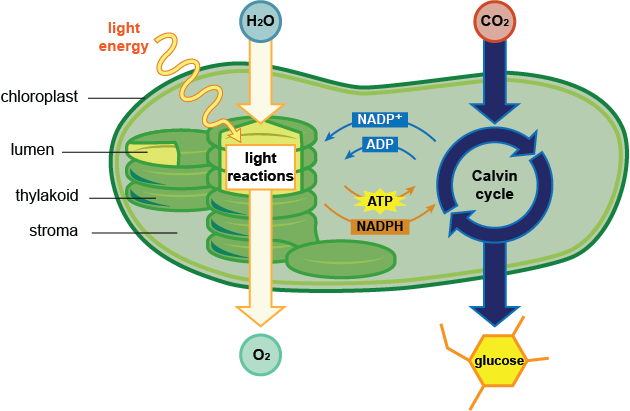
  2. The process of photosynthesis involves many reactions, certain high energy molecules (NADPH and ATP), and special protein complexes not reflected in the summary formula above. Transition students should be familiar with this, and scholar students should know this:
  • there are light-dependent reactions (use light energy from the sun), or simply light reactions - these occur in the lumen and thylakoid membrane of the chloroplast, and use light energy, ADP, and NADP+ to split water  and make oxygen, ATP, and NADPH.

  • there are light-independent reactions (don't need light energy) which together are called the Calvin cycle or dark reactions - these occur in the stroma, and use carbon dioxide, ATP, and NADPH for carbon fixation, creating glucose, as well as NADP+ and ADP which are recycled back to the light reactions.


What if we could make something to harness the energy of the sun, just as plants do, but instead of building sugar molecules we built other complex carbon molecules that could be used as a fossil fuel alternative, or harness it directly into electrical energy? There are scientists and engineers out there tackling these questions today.  

Is there a way to create organic molecules in photosynthesis without using water? Answering this question may help our search for life on other planets, or make it possible to colonize Mars, which has almost no available water and an enormous amount of carbon dioxide (95% of the atmosphere is CO2).  As we continue to observe, study, and test the natural world around us we will be better able to improve lives and solve problems.

Readings and Other Resources

7 Heterotrophs and autotrophs, photosynthesis
RSO Ch. 6 Cell Energy
LOE ch 8 Intro-8.1
CK12 BC 2.18-2.23
CK12 LSC 2.11-2.12
Heterotroph vs Autotroph - All, basic explanation of what heterotrophs and autotrophs are, and an introduction to photosynthesis

Photosynthesis and Pigments - Transition, Amoeba Sisters teach us about pigments in the chloroplasts, and photosynthesis light reactions and Calvin cycle

Leaves and Light - Scholar, a video that talks about the structure of the chloroplasts and how chlorophyll absorbs and reflects certain wavelengths (colors) of light

Photosynthesis Steps and Pathways - All, this video covers both the light reactions and the Calvin cycle in general (Scholars, this is a warm-up for the video below)

Photosynthesis - Scholar, this virtual cell video shows both the light reactions and the Calvin cycle of photosynthesis in detail. You don't need to know all the details, but sometimes studying one level deeper helps you better understand the level you are working at

Photosynthesis Diagrams Worksheet - Scholar, you might want to use these diagrams to help you understand as you read about the different reactions in photosynthesis 


Keep working on your vocabulary lists.

A heads up that our first full lab write-up will be about the cellular respiration experiment we will do on NOV 5.  You will get a pre-lab information sheet this week, and the write-up will be due one week after the experiment, NOV 12.


Monday, October 19, 2015

Wk 5, looking ahead to wk 6


We talked about the 4 types of biological macromolecules, and in fact we built them using paper models.  Some key points to remember from this activity:

  1. macromolecules are made of "building block" components called monomers
  2. every time we synthesize (put together) one monomer to another monomer we release a molecule of water.  This is called dehydration synthesis.
  3. when we break down macromolecules we must use a molecule of water each time we break off a monomer. This is called hydrolysis.
  4. macromolecules are made up of the elements Carbon, Hydrogen, Oxygen, Nitrogen and Phosphorous (remember: CHO, CHO, CHON, CHONP)
Please keep the handout I gave you on macromolecules.  We will talk about them more in the next several weeks.  

Looking ahead to wk 6


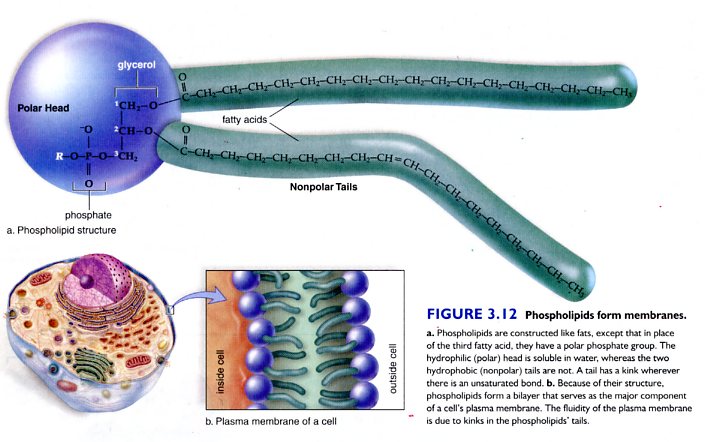
Speaking of macromolecules, next week's readings are on the cell membrane and how things can get in and out of the cell.  The cell membrane is made up of phospholipids.  Remember lipids are fats (one of our macromolecules).  The cell membrane's unique chemical make up (the fact that it is two layers of lipids, both layers with fatty acids pointing inwards) is essential to its function in regulating cell pressure, the passing of materials into and out of the cell, and the communication of the extracellular (outside the cell) environment with the inside of the cell.

The cell membrane makes transport of water, solutes (things dissolved in water), and other things into or out of the cell possible.  This can happen in two general ways:
  1. passive transport - this is movement of substances from areas of high concentration to areas of low concentrations, and requires no energy to happen. Types of passive transport are diffusion, osmosis, and facilitated diffusion.
  2. active transport - this is movement of substances from an area of low concentration to an area of high concentration, and requires the input of energy to happen. This energy is from the molecule ATP (adenosinetriphosphate).  Types of active transport include membrane pumps, endocyctosis, and exocytosis.
These movements through the cell membrane happen in order for the cell to maintain homeostasis.  Read all about it, and watch the videos for wk 6 (they are linked below).

The main focus of co-op class for week 6 is the Cell Models mini project share!  Don't forget to bring your cell model in to class on Thursday.  You can bring your model into the kitchen and set it on the counter (or in the fridge if it is food) at the beginning of co-op if you wish.  Be sure that you have looked over the handout to know all the things your model needs to have.  And have fun being creative!

Wk 6 readings and other resources

6 Cell membrane structure, active and passive transport

In class sharing of Cell Model mini project
Ch. 5 Let's Get Things Moving
LOE chapter 6
CK12 LSC 2.7 - 2.10
Cell Membrane - All, video on discovery of the bilipid membrane structure

Cell Membrane - Transition, the Amoeba Sisters point out the important role of the cell membrane

Passive Transport - Transition, the difference between osmosis and diffusion

Osmosis - Transition, Amoeba Sisters explain osmosis


Diffusion - Scholar, our awesome Aussie friend explains diffusion

Osmosis - Scholar, our awesome Aussie friend explains osmosis

Passive Transport 1 and Passive Transport 2 Scholar, detailed descriptions of passive transport, and different kinds of passive transport

Active Transport - Scholar, detailed description of how active transport works and different kinds of active transport


Sunday, October 11, 2015

Cell Model Project

Here are some various examples of how some people created cell models

Animal cell done in styrofoam and other craft supplies

Animal cell done in watermelon, orange, and candies

Animal cell made from a chair, pillow, and other fabric items

Animal cell pizza

Stuffed animal cell

Animal cell out of jello and candies

Plant cell done in basket and craft supplies

Plant cell of cardboard, dough and twine

Animal cell out of paper mache? and dough

Plant cell of fabric, foam, and craft supplies

Animal cell of ziplock bag, bouncy ball, pipe cleaners, etc.

Plant cell shrink-dink

Various cell models

Here are three prokaryotes!

Wk 4, look ahead to wk 5

This week in lab we were looking more closely at cells.  We talked about the reading, emphasizing cell organelles.  These organelles are the structures which perform functions in order for the cell to carry out life processes.  We then tried a new slide technique, staining, in order to better see the organelles inside the cell.  Using iodine, we stained plant cells (from an onion), making their cell walls and nuclei visible.  Using methylene blue, we stained animal cells (human cheek cells), making their nuclei - and a good number of bacterial cells, too - stand out dark blue.

A Little Review

I think it's a good idea to look back on what we have covered so far, and highlight the key ideas:
  1. biology is the study of life and living systems
  2. the scientific method is a procedure to pursue truth about the nature of the world around us and is based on testable evidence; it does not and cannot speak to matters of faith; it is not a linear process, but cycles back on itself often before we ever reach a "Conslusion"; we accept current theory until we can replace it with a better fit theory
  3. prokaryotes and eukaryotes are classified based on key characteristics: presence or absence of a nucleus, presence or absence of membrane bound organelles; all living things are either prokaryotes or eukaryotes (prokaryotes are bacterias, eukaryotes are all the rest)
  4. the Cell Theory: all living things are made up of cells, new cells come from preexisiting cells, and cells are the fundamental unit of life
  5. cells have organelles - structures which perform functions for the cell
  6. basic microscope use techniques, including how to focus, the scale of magnification, how to measure things you see under the scope, creating a wet mount slide, creating a stained slide

Looking ahead to wk 5

In the next 7 weeks we will be learning about many amazing things that happen at the level of the cell - how things get into and out of the cell, how eneregy is created, how cells create new cells, how DNA is replicated and the code translated.  But before we can study any of those things we need to talk about chemistry, and things even smaller than cells.

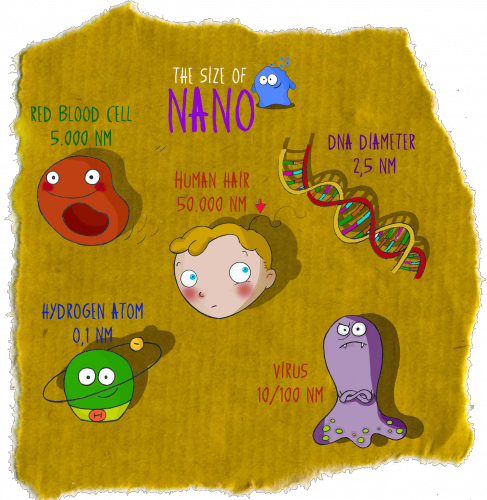
The cellular level of organization is very small (micrometers, or 1/1000 milimeter, or 1/1,000,000 meters), but to talk about what goes on inside the cell we have to look even smaller (nanometers, or 1/1,000,000,000 meters).  The difference between micro and nano scale is like the difference between the size of an adult man and the size of an ant.


See the readings, videos, and activities of week 2 if  you still need help understanding scale, and these incredibly small sizes.

I marked the things you should be working on this week below with RED captions.

Readings and Other Material for Wk 5


5 Basic chemistry principles for biology, atomic/chemical/molecular/cellular structures of life
RSO

Ch. 4 Chemistry of Biology
CK12BC sections  1.9-1.13

CK12 1.9-1.10

LOE Ch. 2


Mini Project #1 - Cell Models

On Thursday we handed out the first mini project of the year - Cell Model.  All the instructions from the model are on the handout, but please contact me if you have questions.  On the reverse side is a rubric that we will use when we bring our models in to share.  On the 22nd we will all bring models to class and spend class time celebrating each others projects, and giving constructive feedback.

See the next blog post for examples of cell models.


Vocabulary List

Don't forget to work on your vocabulary list.  As you read and find new biology words which use Latin and Greek roots record them on your vocabulary list.  See last week's post for more details.

Friday, October 2, 2015

Wk 3 Recap, Looking at wk 4

This week in lab we did three main things - 1. made wet mount slides, 2. learned to estimate the size of things we see under the microscope, and 3. examined prokaryotes and eukaryotes under the microscope.  There is always a lot to do on lab days, and never enough time!  I don't think everyone got to hear about the Vocabulary Challenge, so please read carefully.


1. Wet Mount Slides


Wet mounts are one type of slide.  They are quick and easy, which is nice, but they dry out quickly and do not show as many cellular features as stained slides.  We will use wet mount slides often, but will also learn hanging drop slides, stained slides, and other slide preparation methods.


2. Estimating the size of things under the microscope


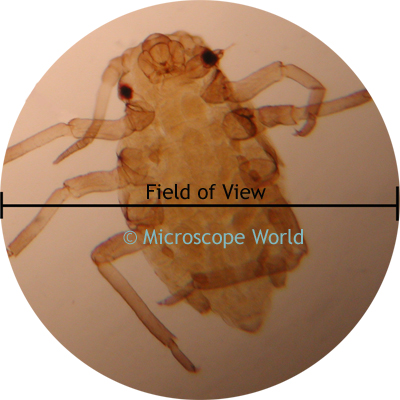
By measuring our field of view, the distance from one side to the other of the circle we see while looking in the microscope, at each level of magnification we can then use this "calibration" to estimate the size of objects we are viewing.  This task took much more time than the others, and I am afraid many did not get enough time to understand. We will need this skill for future labs.  I found a great interactive tutorial which takes you through this steps of calibrating and measuring.  Please do the interactive tutorial. Use of calculators is perfectly acceptable.


Go HERE for the tutorial.  
You will know you understand how to measure with the microscope if you can get the final answers of the interactive correct.


3. Prokaryotes vs Eukaryotes


If anyone would like their own "cootie catcher" for reviewing prokaryotes and eukaryotes here is the file.


Vocabulary Challenge

Science, and especially biology it seems, uses so many large and strange words it sometimes seems like a foreign language.  Actually, much of the vocabulary is taken from two foreign languages - Latin and Greek.  We use Latin and Greek roots, prefixes, and suffixes so much in science it's really worth investing some time to learn them.  You might even be able to understand a new word's meaning just by knowing it's Latin and Greek components.  For example, the word bipedal: bi- means two, and ped- means foot, so a bipedal animal walks on two feet.


I am issuing a challenge: 
By the end of the year transition students need to find 50, and scholar students 100, vocabulary words from your reading for biology class which contain Latin/Greek components.  You will keep track of this list of words and their Latin/Greek components and bring it in when complete.  Your list should look something like this:

1) hypothesis - a proposed explanation based on limited evidence    hypo- (under) thesis (placing)
2) biology - the scientific study of life and living organisms              bio- (life) -logy (branch of study)


For your convenience I have included reference sheets with roots/prefixes/suffixes and their meanings listed.  See the links at the top of the blog page. There is a yet-to-be-determined reward for completing the challenge before the end of the school year.


Looking ahead to wk 4


Next week's readings are about the components of the cell - organelles.  There is also information on cellular specialization - some cells are liver cells, some blood cells, some skin cells, etc - and on the differences between plant and animal cells.  I always seem to find more resources each week, and I don't put them all on the blog because I don't want to overwhelm anyone.  If there is any topic you don't feel you understand well yet, chances are there is another video or web-based activity out there to help you.  You can email me or search the internet to find them (please follow your household rules on internet use - don't just go google something unless you have parent permission).

Week RSO LOE CK12 BC CK12 LSC Other Resources
4 Components of a cell, cellular specialization, plant vs animal cells, stained slide

*Project 1 "Cell Model" explained
Ch. 3 Inside Story Ch 5.2
Ch 5.3
(Ch 5.4)
Ch 5 Review
2.1
2.4
2.5
2.6
2.7
2.8
2.9
2.10
2.11
2.3
2.4
2.5
2.6
Inside a Cell worksheet for taking notes about cell structure/organelles as you read

Cellcraft: online game where you delve into the world of the cell, learning about how a cell functions while helping it survive in hostile environments

Cell Membrane video on structure and function of the cell membrane (this will be helpful for week 6, too)

Cells Alive interactive close-up look at the differences between plant and animal cells

Crash Course - Eukaryopolis scholar These Crash Course videos move fast and contain a lot. You might watch them before reading, but you will get the most out of them by watching after you have read.


In lab next week we will work on staining slide specimens in order to better distinguish some of the smaller structures.  To be ready for next Thursday, watch this short video on how to mount and stain a sample of cheek cells.  We will be doing this and another staining procedure in class.