
We talked about the 4 types of biological macromolecules, and in fact we built them using paper models. Some key points to remember from this activity:
- macromolecules are made of "building block" components called monomers
- every time we synthesize (put together) one monomer to another monomer we release a molecule of water. This is called dehydration synthesis.
- when we break down macromolecules we must use a molecule of water each time we break off a monomer. This is called hydrolysis.
- macromolecules are made up of the elements Carbon, Hydrogen, Oxygen, Nitrogen and Phosphorous (remember: CHO, CHO, CHON, CHONP)
Please keep the handout I gave you on macromolecules. We will talk about them more in the next several weeks.
Looking ahead to wk 6
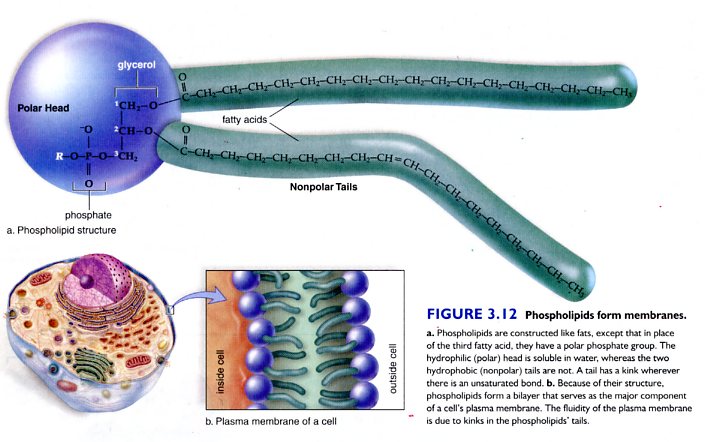
Speaking of macromolecules, next week's readings are on the cell membrane and how things can get in and out of the cell. The cell membrane is made up of phospholipids. Remember lipids are fats (one of our macromolecules). The cell membrane's unique chemical make up (the fact that it is two layers of lipids, both layers with fatty acids pointing inwards) is essential to its function in regulating cell pressure, the passing of materials into and out of the cell, and the communication of the extracellular (outside the cell) environment with the inside of the cell.
The cell membrane makes transport of water, solutes (things dissolved in water), and other things into or out of the cell possible. This can happen in two general ways:
- passive transport - this is movement of substances from areas of high concentration to areas of low concentrations, and requires no energy to happen. Types of passive transport are diffusion, osmosis, and facilitated diffusion.
- active transport - this is movement of substances from an area of low concentration to an area of high concentration, and requires the input of energy to happen. This energy is from the molecule ATP (adenosinetriphosphate). Types of active transport include membrane pumps, endocyctosis, and exocytosis.
These movements through the cell membrane happen in order for the cell to maintain homeostasis. Read all about it, and watch the videos for wk 6 (they are linked below).
The main focus of co-op class for week 6 is the Cell Models mini project share! Don't forget to bring your cell model in to class on Thursday. You can bring your model into the kitchen and set it on the counter (or in the fridge if it is food) at the beginning of co-op if you wish. Be sure that you have looked over the handout to know all the things your model needs to have. And have fun being creative!
Wk 6 readings and other resources
|
6 Cell membrane
structure, active and passive transport
In class sharing of
Cell Model mini project
|
Ch. 5 Let's Get
Things Moving
|
LOE
chapter 6
|
CK12 LSC 2.7 - 2.10
|
Cell Membrane - All, video on
discovery of the bilipid membrane structure
Cell Membrane - Transition, the
Amoeba Sisters point out the important role of the cell membrane
Passive Transport - Transition, the
difference between osmosis and diffusion
Osmosis - Transition, Amoeba Sisters
explain osmosis
Diffusion
- Scholar, our awesome Aussie friend explains diffusion
Osmosis
- Scholar, our awesome Aussie friend explains osmosis
Passive
Transport 1 and Passive
Transport 2 Scholar, detailed descriptions of passive transport, and
different kinds of passive transport
Active
Transport - Scholar, detailed description of how active transport works
and different kinds of active transport
|

No comments:
Post a Comment
Note: Only a member of this blog may post a comment.