Thursday, March 31, 2016

Wk 10, Looking Ahead to Wk 11

Wow - there are only 6 weeks of class left!  I'm excited for summer, but sad to find the year wrapping up and still so much amazing stuff to cover in biology!!

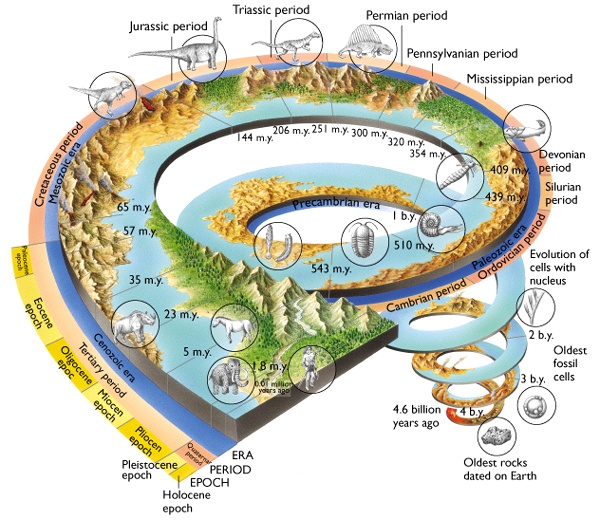
Today in class we examined the looooooong history of the earth, and the relative distances and location of major events along the timeline.  We plotted these events on a 4.6 meter strip, representing the 4.6 billion years of earth's history.  We then began making calculations to correlate the entire course of earth's history into a calendar year.  On what day does the first eukaryote cell appear? On which day do the dinosaurs die out on?  Finish making your calculations to find out!


Week 11 - Evolutionary Mechanisms

So, how did all the change happen? Slowly.  Evolution is a change in the gene pool over time (big changes usually taking much greater lengths of time).  There are 5 main processes that can cause evolution, and evolution can be both small scale (microevolution) and large scale (macroevolution).

Five main processes that can cause evolution

  1. small population size
  2. non-random mating
  3. mutation
  4. gene flow
  5. natural selection 

All of these process can lead to microevolution - the change in the gene pool over time.  Microevolution looks at evolution from the organisms level down to the genetic level.  Macroevolution looks at major changes above the species level, for example the evolution of birds from dinosaurs.

We have two weeks before we meet again.  I hope your break is filled with fun, and lots of biology! Here are the readings and other resources


Evolution 2 - Mechanisms
Ch. 21 How
LOE Ch 3
CK12 BC 5.12-5.25
CK12 LSC 4.1-4.3
Natural Selection and the Bacterial Resistance - transition, Amoeba Sisters use bacterial resistance to antibiotics to illustrate the principle of natural selection

Evolution - transition, an overview of evolution by means of natural selection

Five Finger of Evolution - both, Paul Anderson (from Bozeman Science) gives a great TedTalk with animation covering the basic principle of evolution and the 5 processes that can cause evolution

What is Evolution - scholar, Stated Clearly video overviews evolution

What is Natural Selection? - scholar, Stated Clearly video covers natural selection and it's place in the theory of evolution


Remember:

  • do the readings and watch the videos
  • work on astrobiology project
  • keep doing your vocabulary list (I will need to see them to order the sticker prizes by April 28th)
  • read and think about Frankenstein or Jekyll/Hyde
  • have a great Spring Break


Sunday, March 27, 2016

Astrobiology Mini Project

UPDATE: Find the instructions for Timeline, Design a Spacecraft, and Wolf Trap here.

I am so excited for this project!

Astrobiology is the study of life as a planetary phenomenon.  It tries to understand the fundamental nature of life on earth and the probability of life elsewhere.  Astrobiology is multidisciplinary - it combines astronomy, biology, chemistry, geology, and even engineering and philosophy.

To work in astrobiology, or on an astrobiology mini project, requires taking your knowledge and understanding of biology and applying it in new ways to analyze, evaluate, and even create. 

This mini project has two sections.  The first section, Computational Connections, is a series of questions and step-by-step instructions for mathematical calculations.  Math is the language of science, and practicing calculations, charting, graphing, and applying the results to the scientific process are essential scientific skills.

The second section, Project Choice Menu, is the crux of this project.  You will choose 3 squares from the menu to complete (transition students choose 2), one each from the Analyze, Evaluate, and Create rows.  There are a lot of choices for how to demonstrate your work, and if you have an additional idea you would like to use please talk to the teacher.  Many of the choices on the project menu have an additional handout and instructions.  Please ask your teacher for the ones you need.

When you have finished the mini project please hand in the three handouts from Computational Connections and all materials from the Project Choice Menu.

The linked Project Instructions explain what the project is about and the requirements, and has the Project Choice Menu.

The three files needed for the Computational Connects portion are 

If you choose Wolf Trap, Timeline, Design a Space Craft, or Bioengineer you will need to email the teacher for additional instructions.

Additionally, here are resources we used in class that may be helpful.
And the Pinterest Board for generating ideas.


If you still have questions about the project, email your teacher!

Wk 8 and 9, Looking Ahead to Wk 10

Animalia

We spent two weeks on kingdom Animalia.  During week 8 we covered invertebrate animals and their phylogenetic relationships.  In class we practiced using a dichotomous key to classify sample invertebrate organisms.
 Remember, a dichotomous key is for identifying things you come across and is NOT indicative a any sort of relationship between organisms on the key.  It relies heavily on morphology.  

If you missed out on the dichotomous key activity (or you just loved it and can't get enough) here is an activity on using dichotomous keys.

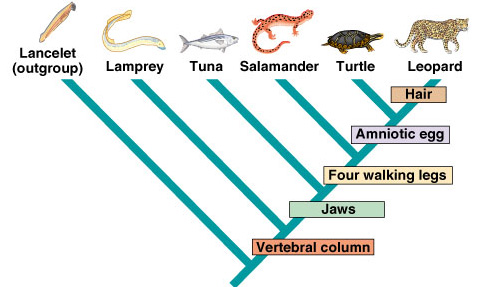
The second week was spent with chordates, including the vertebrates.  We practiced making a cladogram - a chart showing the evolutionary relationship between groups of organisms based on shared derived characteristics. 

If you missed out on the cladogram activity (or you just loved it and can't get enough) here is an activity on cladograms - what they are, what they show, how to build them, and a chance to make a simple one of your own.

Though our example cladogram was imperfect and relied on morphology as well, typically cladograms utilize embryological, developmental, or genetic shared derived characteristics because these more accurately reflect an evolutionary relationship.

And speaking of evolution...


Wk 10 Evolution 1 - History of Life on Earth

This week begins our unit on evolution.  Evolution is a fundamental concept in biology. The Theory of Evolution is often seen as the main overarching theme that ties all topics of Biology together. It includes Genetics, Population Biology, Anatomy and Physiology, Ecology, Animal Behavior, and Embryology, among others.  The topic is controversial for some, and I encourage you to talk with your parents about it (and all the things we cover in class!), but our class will study the theory of evolution as it is currently understood and accepted by the scientific community at large.  We will not cover the origins of life, as evolution does not address this directly, but rather the (inheritable) change in life.


  • Evolution is the heritable (genetic) change in a population or species over generations.
  • Species is a group of organisms which can successfully interbreed and whose offspring could also successfully interbreed.
  • Population is a group of interacting individuals belonging to one species and living in the same geographic area.

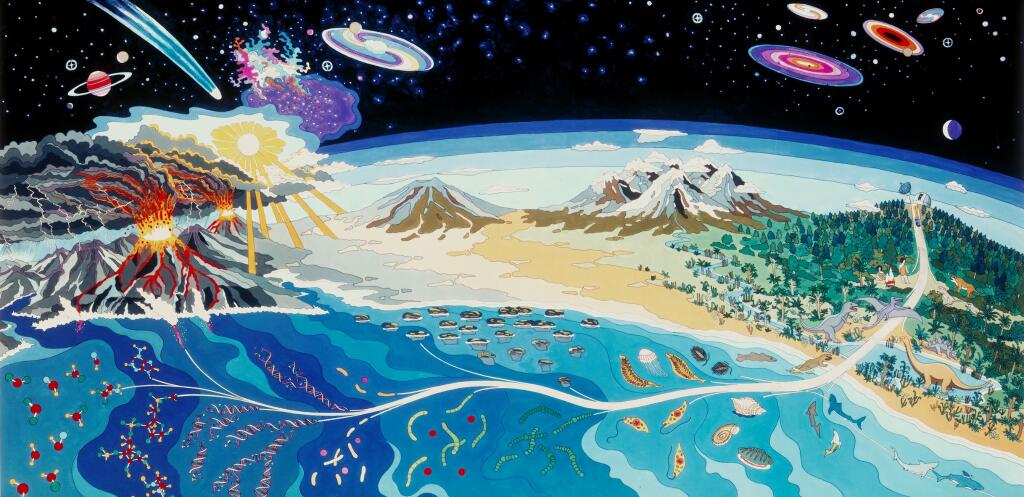
Before we get into the process of evolution (wk 11) we need to discuss the history and diversity of life on earth.  We just spent six weeks covering taxonomy and diversity.  The variety of  living (extant) organisms on earth is quite amazing!  And collectively, all current living organisms represent only a portion of the many, many organisms that have lived (and become extinct).  The earth has existed for over 4.5 billion years, and evidence of life goes back over 3 billion years.


In that 3+ billion years of life on earth many species have evolved, and then become extinct, or evolved into new species. There is a complex interaction between organisms and their environment (by the way we call the study of this ecology), and as the earth changed, the life on it also changed.  There have been major periods of heating and cooling, changes in the composition of the atmosphere, changes in the amount of available water, asteroids hitting the earth, periods of extensive volcanic activity, and the shifting of tectonic plates (and therefore land mass) on the surface of the earth.  All of these environmental factors interacted in a dynamic (back and forth) way with the organisms on earth, creating periods of growth and diversification of life as well as extinction events.


Readings and Other Resources

Evolution 1 -History of Life on Earth
Ch. 20 A Story of Luck
LOE 4.3
CK12 BC 5.1-5.9
CK12 LSC 4.12-4.14
Life Has a History - both, choose Level 2, this is an interactive overview of the topics covered in the three weeks of our evolution unit

History of the Earth in 5 1/2 Minutes - both, this animated comic gives you an idea of the length of geologic time, the age of the earth, the amazing events that have happened, and where modern life fits in to that scale.

The History of Life on Earth - scholar, CrashCourse, I know this is from their Ecology course, but it covers this first week of evolution very well

So for this week make sure to:

  • do the readings and other resources on the chart
  • email me if you need anything for your astrobiology project
  • keep working on your vocabulary lists
  • read in Frankenstein/Jekyll & Hyde


Tuesday, March 15, 2016

Wk 7, looking ahead to wk 8

Plantae!


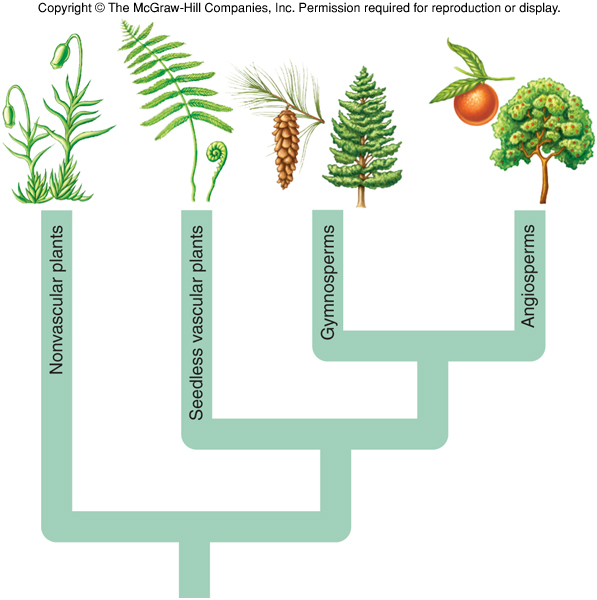
We covered the four major plant groups in lab.  These are the bryophytes, seedless vascular plants (tracheophytes, pteridophytes, lycophytes, etc), gymnosperms, and angiosperms.  There are other plant groups, but these four comprise the majority of plant life.  Remember all plants:
  • are eukaryotes
  • are multicellular
  • are autotrophs
  • have cell walls composed of cellulose
  • undergo alternation of generations
Some major differences between the four groups are summarized in the table below.

Bryophyta Pteridophyta, etc. Gymnosperms Angiosperms


Dominant phase
Gametophyte Sporophyte Sporophyte Sporophyte
Ploidy of plant body
Haploid Diploid Diploid Diploid
Vascular Tissues
absent present advanced advanced
True Leaves
absent present advanced advanced
Roots
absent absent advanced advanced
Seed and covering
Seed absent Seed absent Seed present, naked Seed present, coverings
water required for fertilization
yes yes no no
Flower presence
absent absent absent present
There was insufficient time to get around to all the plant specimen and examine them, so there will be no write-up for this lab!  Don't worry, there are still 3 more write-ups before the end of the year ;-)

Introducing Animalia

What is an animal? Lions, tigers, and bears (oh my!)? Sure.  
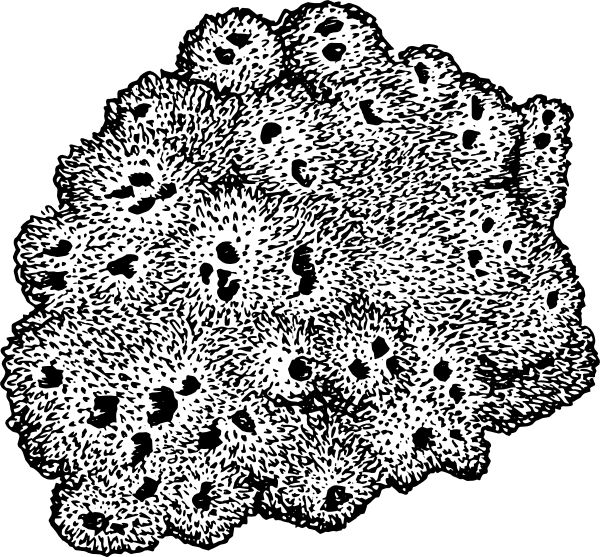
Sponges, corals, and urchins? Yes, those too. 


Rotifers and nematodes? Yup.
Weird? Well, there is incredible variety in kingdom Animalia!  But organisms in this kingdom all share a few key characteristics:
  • eukaryotic
  • multicellular
  • heterotrophic
  • motile

We start to break the animals into different groups by first looking at whether or not the organism has tissues, and whether the developing embryo has germ layers. How animals develop from a fertilized zygote into a morula, then into a blastula, and then possibly a gastrula, and the associated germ layers, is used extensively in classifying animals.  

Next we look at what kind of symmetry the organism has - radial or bilateral - and the number of germ layers - 2 (diploblastic) or 3 (triploblastic). (Sponges are the only phyla in kingdom Animalia which are asymmetrical, but they were already branched off our classification system because they have no tissue or germ layer).


Of those organisms which are triploblastic with bilateral symmetry, we can make a further distinction based on whether they have a body cavity (called a coelom).  Those without body cavities are called acoelomates, those with an incompletely lined, fluid-filled coelom are called pseudocoelomate, and those with a completely lined, fluid-filled coelom are called coelomates (sometimes the word eucoelomate is used).

We can further divide the coelomates into protostomes and deuterostomes, depending on whether the first opening formed in embryological development is the mouth or the anus.

So, a visual representation of all these classification can be put into a cladogram like the one below.

The phyla on this cladogram (Porifera, Cnidaria, Ctenophora, etc) are representative groups, but only a few of the 35+ phyla in the animal kingdom. 

This week we are focusing on invertebrate phyla, or every single phylum in the animal kingdom except phylum chordata.  Next week we will focus on phylum chordata.

Readings and Other Resources


14 Kingdom Animalia -  Invertebrates
Ch. 31 Kingdom Animalia
 pgs 639-943
LOE ch 30, 31, 32
CK12 BC 10.1-10.8
(these sections are short)

CK12 LSC 10.1-10.7
 (these sections are short)
Animals - transition, Bozeman science does an overview of the kingdom and the ways we classify animals within the kingdom

Marine Invertebrates - transition, simple video with a variety of beautiful and interesting invertebrate animals

Animal Development - scholar, CrashCourse covering animal development, which is used in classifying the organisms in the kingdom  - or -

Introduction to Animal Diversity - advanced scholar, if you want deeper understanding then watch this instead of the CrashCourse Animal Development Video. It is an excellent overview of the classification of the animal kingdom! There's much in here that is lacking in the readings.  While you don't have the lecture note outlines he talks about, it would be very helpful to get a blank piece of paper, when prompted, and create the Animalia classification key along with him

Simple Animals: sponges, jellies, and octopuses - scholar, CrashCourse covers a few of the simpler animal phyla

Complex Animals: Annelids and Arthropods - scholar, CrashCourse covers more complex animal phyla


Sunday, March 6, 2016

Wk 6, Looking Ahead to Wk 7


I hope you read all about Protista and Fungi in week 6.
 If you couldn't get enough of it, here are links you might be interested in.   This one is about a group of fossilized fungi thought to be the oldest fossil of a land dwelling organism. And here is an article about an amoeba with an immune response and how it might be helpful in developing treatments for human immune diseases. This one features the musical talents of some teenage biology students extolling the wonders of Protista. And apparently Protista, besides giving rise to Fungi, Plantae, and Animalia, are the ancient Muses of biology rap and have inspired yet another video.

Oh, and check out this article about sending cryptoendolithic fungus into space to see how it fared in mars-like conditions.

ET Found Home?

And speaking of life beyond earth... This week in class we discussed the conditions necessary for life on earth or anywhere for that matter.
Liquid Water
Source of Energy (for photosynthesis, chemosynthesis, etc)
Raw Materials (i.e. organic molecules for building cell structures)
Protection from Radiation
Temperatures at which life has been known to exist (roughly -15 to 120 degrees C)

We then took these parameters and evaluated extraterrestrial planets (and moons) to see which are the most likely to be able to support life. Here is a video that explains astrobiology in simple terms.
This week we will quickly finish up talking about astrobiology, hand out the Astrobiology Mini Project, and move on to the evolution and diversity of kingdom Plantae.

Kingdom Plantae

The plant kingdom has amazing variety, but all species in the kingdom share certain characteristics.  They are all
  • eukaryotes
  • autotrophs
  • multicellular
  • have cell walls made of cellulose
  • undergo alternation of generations (spend a portion of their lives as haploid organisms, and a portion in diploid form)
The kingdom is made up of many monophyletic groups, but four of these represent the overall phylogenetic diversity of the kingdom.  These are the primitive non-vascular  mosses and liverworts (Bryophytes), the vascular but seedless ferns (Pteridophytes), the vascular naked-seeded plants like pines (Gymnosperms), and the vascular flowering plants (Angiosperms).

Kingdom Plantae includes species which have undergone amazing adaptations (we'll talk more about this in the evolution and ecology units), which account for both variety in beauty and function.  They've also made some pretty weird adaptations too.  Check out this week's videos for more.


13
RSO Ch. 30 Kingdom Plantae
LOE ch 29
CK12 BC 9.1-9.10 and 9.18-9.24
CK12 LSC 7.1 and 7.4-7.14
Plant Evolution - transition, this video has no sound, but gives you a visual walkthrough of plant evolution and the major groups (taxa) of plants

Plants Intro - scholar, Bozeman Science video that gives a great intro to the variety of plant
Life

10 Most DEADLY Plants on Earth - both, making plants more intriguing, and showing some variety

Monocots vs Dicots - both, how to identify these two types of flowering plants, and a few exceptions

Plants Behaving Badly: Murder and Mayhem - IF YOU WANT here is a 45 documentary about carnivorous plants, narrated by David Attenborough.  This also makes nice connections to evolution and ecology, our next two units

So for week 7
  • do the readings and watch the videos
  • keep accumulating vocabulary words
  • get your copy of Frankenstein or Jekyll and Hyde lined up (begin reading if you wish, but  if you get stuck or feel overwhelmed I will be handing out a reading guide for Frankenstein in week 8)