I hope you read all about Protista and Fungi in week 6.

Oh, and check out this article about sending cryptoendolithic fungus into space to see how it fared in mars-like conditions.
ET Found Home?
And speaking of life beyond earth... This week in class we discussed the conditions necessary for life on earth or anywhere for that matter.
Liquid Water
Source of Energy (for photosynthesis, chemosynthesis, etc)
Raw Materials (i.e. organic molecules for building cell structures)
Protection from Radiation
Temperatures at which life has been known to exist (roughly -15 to 120 degrees C)
Source of Energy (for photosynthesis, chemosynthesis, etc)
Raw Materials (i.e. organic molecules for building cell structures)
Protection from Radiation
Temperatures at which life has been known to exist (roughly -15 to 120 degrees C)
We then took these parameters and evaluated extraterrestrial planets (and moons) to see which are the most likely to be able to support life. Here is a video that explains astrobiology in simple terms.
This week we will quickly finish up talking about astrobiology, hand out the Astrobiology Mini Project, and move on to the evolution and diversity of kingdom Plantae.
Kingdom Plantae
The plant kingdom has amazing variety, but all species in the kingdom share certain characteristics. They are all- eukaryotes
- autotrophs
- multicellular
- have cell walls made of cellulose
- undergo alternation of generations (spend a portion of their lives as haploid organisms, and a portion in diploid form)
The kingdom is made up of many monophyletic groups, but four of these represent the overall phylogenetic diversity of the kingdom. These are the primitive non-vascular mosses and liverworts (Bryophytes), the vascular but seedless ferns (Pteridophytes), the vascular naked-seeded plants like pines (Gymnosperms), and the vascular flowering plants (Angiosperms).
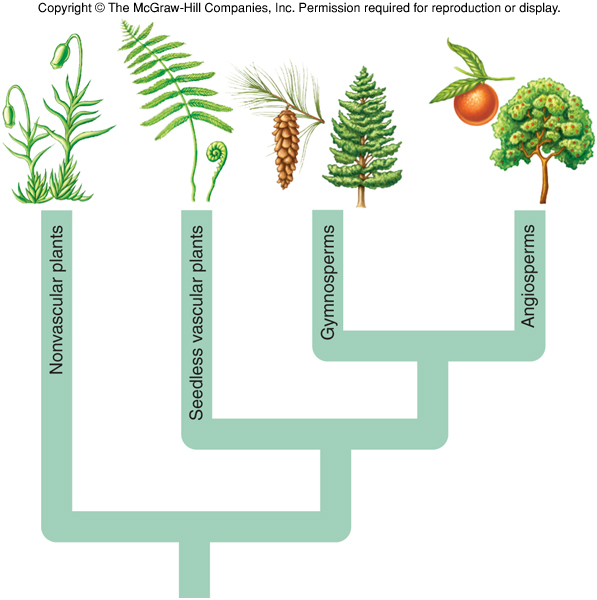
Kingdom Plantae includes species which have undergone amazing adaptations (we'll talk more about this in the evolution and ecology units), which account for both variety in beauty and function. They've also made some pretty weird adaptations too. Check out this week's videos for more.
13
|
RSO Ch. 30 Kingdom
Plantae
|
LOE ch 29
|
Plant Evolution - transition, this
video has no sound, but gives you a visual walkthrough of plant evolution and
the major groups (taxa) of plants
Plants Intro - scholar, Bozeman
Science video that gives a great intro to the variety of plant
Life
10 Most DEADLY Plants on Earth -
both, making plants more intriguing, and showing some variety
Monocots vs Dicots - both, how to
identify these two types of flowering plants, and a few exceptions
Plants Behaving Badly: Murder and Mayhem
- IF YOU WANT here is a 45 documentary about carnivorous plants, narrated by
David Attenborough. This also makes
nice connections to evolution and ecology, our next two units
|
- do the readings and watch the videos
- keep accumulating vocabulary words
- get your copy of Frankenstein or Jekyll and Hyde lined up (begin reading if you wish, but if you get stuck or feel overwhelmed I will be handing out a reading guide for Frankenstein in week 8)

No comments:
Post a Comment
Note: Only a member of this blog may post a comment.