A Little Review
I think it's a good idea to look back on what we have covered so far, and highlight the key ideas:- biology is the study of life and living systems
- the scientific method is a procedure to pursue truth about the nature of the world around us and is based on testable evidence; it does not and cannot speak to matters of faith; it is not a linear process, but cycles back on itself often before we ever reach a "Conslusion"; we accept current theory until we can replace it with a better fit theory
- prokaryotes and eukaryotes are classified based on key characteristics: presence or absence of a nucleus, presence or absence of membrane bound organelles; all living things are either prokaryotes or eukaryotes (prokaryotes are bacterias, eukaryotes are all the rest)
- the Cell Theory: all living things are made up of cells, new cells come from preexisiting cells, and cells are the fundamental unit of life
- cells have organelles - structures which perform functions for the cell
- basic microscope use techniques, including how to focus, the scale of magnification, how to measure things you see under the scope, creating a wet mount slide, creating a stained slide
Looking ahead to wk 5
In the next 7 weeks we will be learning about many amazing things that happen at the level of the cell - how things get into and out of the cell, how eneregy is created, how cells create new cells, how DNA is replicated and the code translated. But before we can study any of those things we need to talk about chemistry, and things even smaller than cells.
The cellular level of organization is very small (micrometers, or 1/1000 milimeter, or 1/1,000,000 meters), but to talk about what goes on inside the cell we have to look even smaller (nanometers, or 1/1,000,000,000 meters). The difference between micro and nano scale is like the difference between the size of an adult man and the size of an ant.
The cellular level of organization is very small (micrometers, or 1/1000 milimeter, or 1/1,000,000 meters), but to talk about what goes on inside the cell we have to look even smaller (nanometers, or 1/1,000,000,000 meters). The difference between micro and nano scale is like the difference between the size of an adult man and the size of an ant.
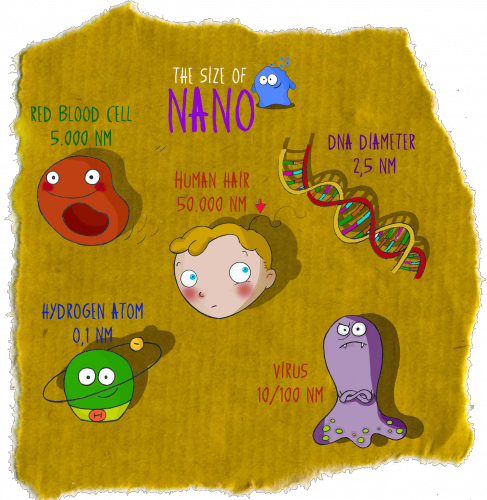
See the readings, videos, and activities of week 2 if you still need help understanding scale, and these incredibly small sizes.
I marked the things you should be working on this week below with RED captions.
Readings and Other Material for Wk 5
Mini Project #1 - Cell Models
On Thursday we handed out the first mini project of the year - Cell Model. All the instructions from the model are on the handout, but please contact me if you have questions. On the reverse side is a rubric that we will use when we bring our models in to share. On the 22nd we will all bring models to class and spend class time celebrating each others projects, and giving constructive feedback.
See the next blog post for examples of cell models.
Vocabulary List
Don't forget to work on your vocabulary list. As you read and find new biology words which use Latin and Greek roots record them on your vocabulary list. See last week's post for more details.
I marked the things you should be working on this week below with RED captions.
Readings and Other Material for Wk 5
5 Basic chemistry
principles for biology, atomic/chemical/molecular/cellular structures of life
|
RSO
Ch. 4 Chemistry of Biology |
OtherResources
Both Chemistry of Biology Transition: Biological Molecules Scholar: Crash Course Water Crash Course Biological Molecules |
Mini Project #1 - Cell Models
On Thursday we handed out the first mini project of the year - Cell Model. All the instructions from the model are on the handout, but please contact me if you have questions. On the reverse side is a rubric that we will use when we bring our models in to share. On the 22nd we will all bring models to class and spend class time celebrating each others projects, and giving constructive feedback.
See the next blog post for examples of cell models.
Vocabulary List
Don't forget to work on your vocabulary list. As you read and find new biology words which use Latin and Greek roots record them on your vocabulary list. See last week's post for more details.

No comments:
Post a Comment
Note: Only a member of this blog may post a comment.