Please excuse my absence

Also, I forgot in the last update to remind everyone about the Respiratory-Circulatory Connection lab write-up! Please don't forget to bring your lab write-up to class this week.
Taxonomy
Taxonomy is the systematic classification of life on earth. With all those millions of species on earth, we need a universal way of talking about them. The answer is taxonomy.People have been classifying their surroundings for time immemorial. Aristotle developed a simple system of classifying living organisms over 2000 years ago. About 300 years ago Carl Linnaeus also developed a system of classification, attempting to make the names we give organisms universal and concise. He used morphology, or the shape (appearance) of things, to put them into groups, and ultimately give each type of organism a two-part name - it's binomial nomenclature. This two part name is made up of two Latin words, one representing an organisms genus and the other the organisms species. For example, the scientific name for a koala is Phascolarctos cinereus.
Sometimes scientists get a little silly and create non-traditional names, but they are still Latin-ized and written in Genus species form. Take for example this beetle in the genus Agra - it's scientific names is Agra cadabra (no kidding!)

Silliness aside, we have a hierarchy of classification groups. The first grouping, Domain, is the most inclusive, will the final grouping, species, is restricted to a single species.

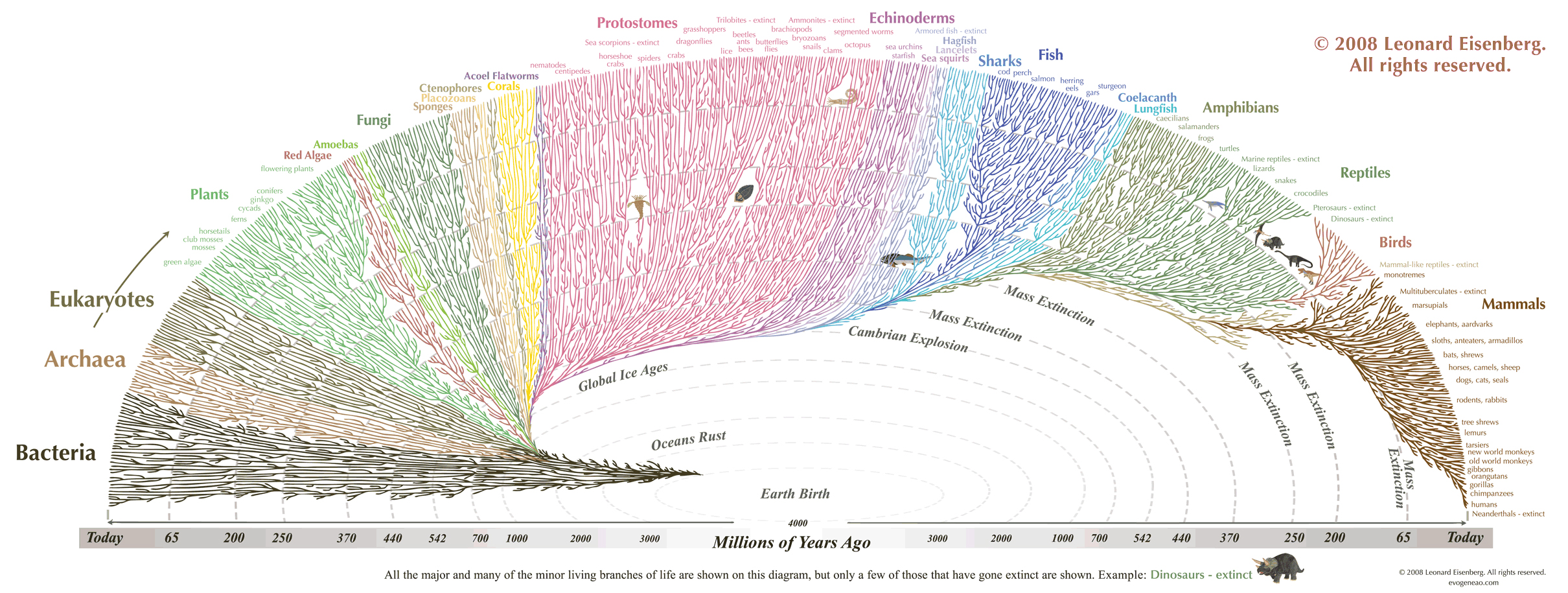
We don't use the exact system that Linnaeus described any longer. Modern taxonomy relies on more than just morphology to classify organisms. We also use physiology, geography, behavior, and (probably most definitively) genetics. Using modern biological technologies we can sequence organisms' DNA and compare them and attempt to put them into a Tree of Life. This is known as phylogenetics. The artistically rendered phylogenetic tree below gives you a visual idea of how we attempt to show the connection of all life to a single evolutionary ancestor.
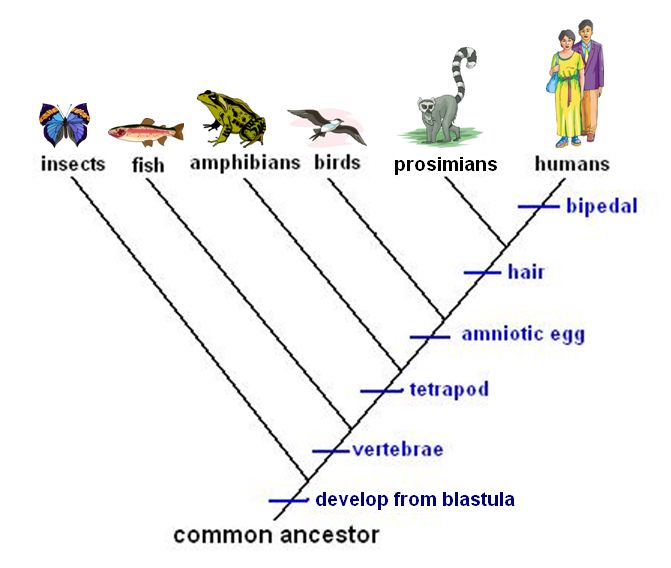
Another tree-like chart we use to show the relationship between both living organisms and extinct ancestors, is called the cladogram. A cladogram depicts the evolutionary relationships among these organisms, each branching point representing a common ancestor, and the spaces between branches representing shared derived characteristic of all the organisms beyond that point on the cladogram. Below is an example of a simple cladogram, with some shared derived characteristics listed.
Looking ahead to Week 4
- Frog Dissection is happening this week!! Come to class prepared, having done the prelab, on time, and ready to work.
- Respiratory-Circulatory Connection lab write up is due this week.
- Don't forget to be thinking about which book you would like to read for the colloquium, and get your hands on a copy.
- Keep working on those vocabulary lists (all sorts of great words in this week's readings!).
Here are the readings and videos for this week
|
4 Classification
and Taxonomy
|
RSO Ch. 28 Taxonomy
|
LOE this week
please use CK12 BC 5.11
|
CK12 BC 5.11
|
CK12 LSC extra
reading
|
Classification of Life - transition,
this is a very basic overview of classification
Taxonomy - scholar, Crash Course
covers basic ideas in taxonomy and overviews the domains and the kingdoms of
eukarya
Phylogenetics - scholar, Bozeman
Science covers phylogenetics, and the basics of reading a cladogram
|

No comments:
Post a Comment
Note: Only a member of this blog may post a comment.