Archaea, Bacteria, and Aliens
 No, I don't mean little green men. Current ideas around life in our solar system (outside of earth) are centered on microscopic life - the kind of life that evolved on earth early in it's 4.5 billion year history. Astrobiology is the study of the origin, evolution, distribution, and future of life in the universe: extraterrestrial life and life on Earth. Astrobiologists currently study the extremophiles of earth, much of which are found in domains Archaea and Bacteria, to theorize what kind of life there might be and where it might be found.
In class this week we discussed some examples of extremophiles, the conditions in which they live, and similar conditions predicted on extraterrestrial - this just means outside of earth - bodies (moons, planets, comets, etc). Astrobiology is currently a rather young and small field of science. However, with ever increasing interest in space and in human travel in space, astrobiology will likely grow in importance. And in the mean time it makes studying Archaea and Bacteria a little more interesting!
For week 6 we will begin our next mini project - Earth as a Model for Alien Worlds.
Looking Ahead to Wk 6
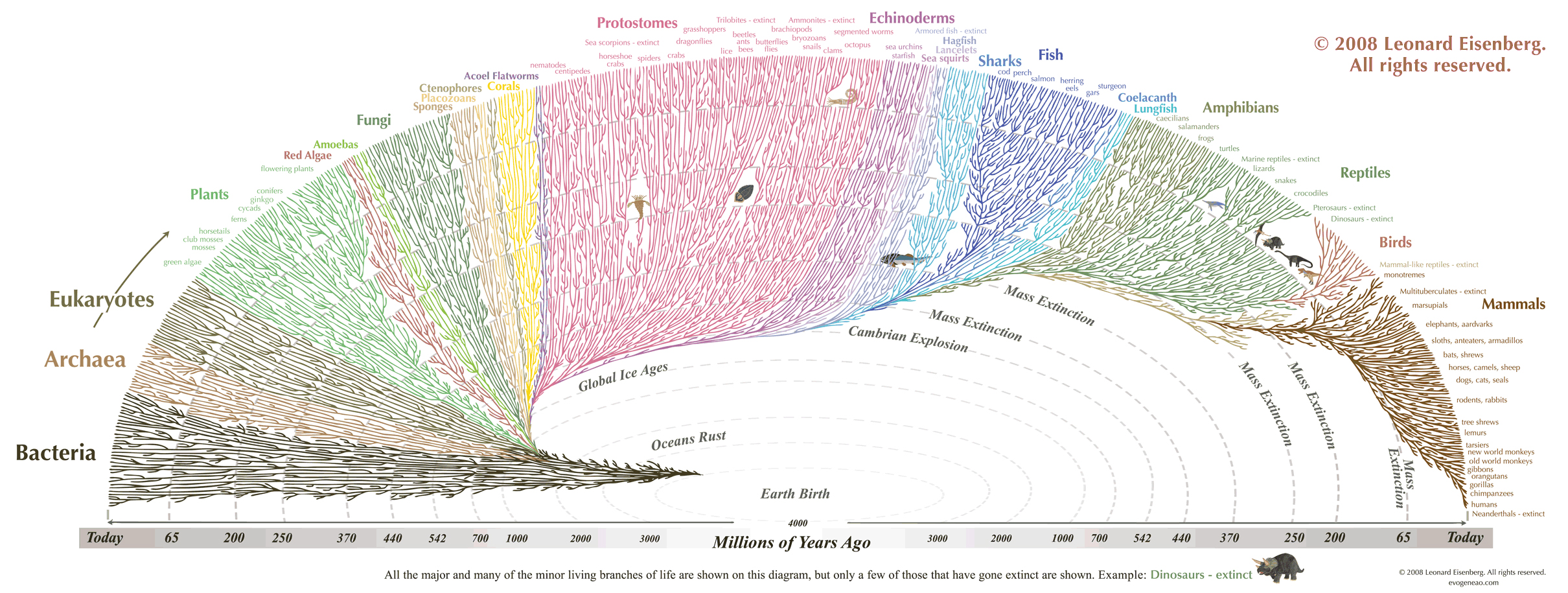
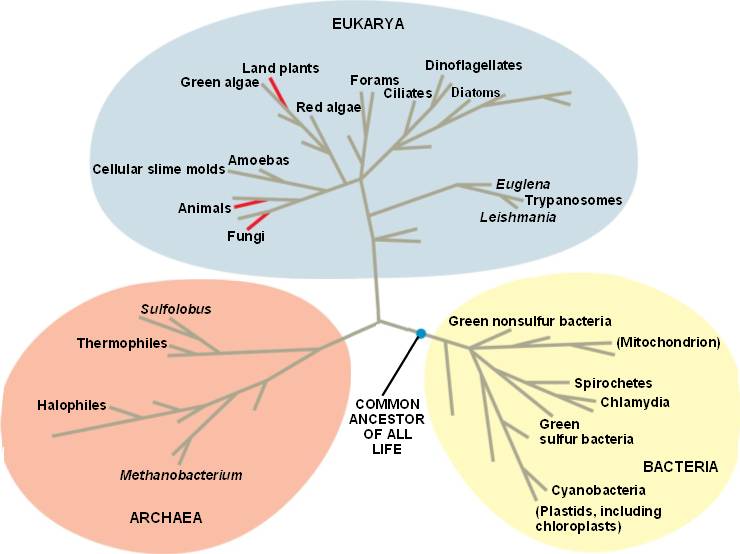
This week we will cover two of the kingdoms in domain Eukarya. Recall that all life can be classified into one of three domains, Archaea, Bacteria, or Eukarya. Archaea and Bacteria contain prokaryotic life, while Eukarya is full of eukaryotes. Domain Eukarya is made up of four kingdoms - Protista, Fungi, Plantae, and Anamalia.
Protista
Protists are a group of mainly unicellular eukaryotes, though some are colonial and some, like algae, are multicellular. As eukaryotes they have a nucleus and membrane bound organelles. Protists can be motile (move around) using a variety of means like flagella and cilia, or they can be immobile. They have a variety of reproductive strategies - asexul, sexual, or sometimes combinations of the two. They can be heterotrophs or autotrophs.
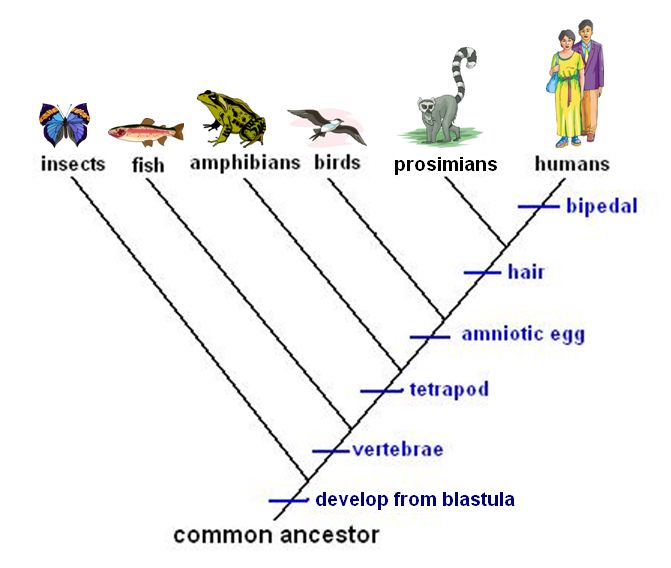
Really, the group is best defined as all eukaryotes except animals, plants, and fungi. In this sense kingdom Protista is not monophyletic. As scientists study more about the great variety of protists the phylogeny (evolutionary relationships) will become more clear. By the time you are teaching biology to your own children it is very likely the classification for this group will have changed.
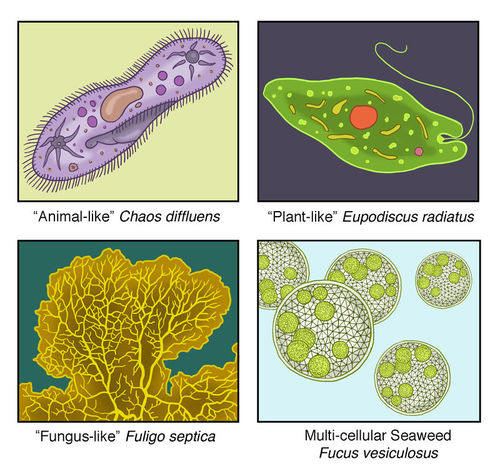
Protists are generally categorized as animal-like (the protozoans), plant-like (the algaes, diatoms, dinoflagellates, and euglenoids) or fungus-like (the slime molds).
Fungi
Fungi have a great diversity of morphology and habitat. They are heterotrophic, typically secreting enzymes out of their bodies to digest other organisms and then reabsorbing the digested nutrients. They have cell walls made of chitin, while the cell wall in plants is made of cellulose. They are often symbiotic or parasitic to plants or animals. They have a variety of reproductive strategies - sexual and asexual, and even periods of their life cycle in which they do not reproduce at all. Structurally, fungi are made up of fine, feathery filaments called hyphae. These hyphae can combine into mycelium. You may notice mushrooms have a spongey feel to them - this is because it is not exactly solid but made up of a mass of tightly packed hyphae.
Kingdom Fungi has five main phyla - the sac or cup fungui and yeasts (the ascomycota), the club fungus (the basidiomycota), the mostly single-celled, aquatic plant parasites called chytrids (the chytridiomycota), the plant symbiotic mycorrhiza or AM fungi (the glomeromycota), and the zygospores (the zygomychota).

And sometimes when you have protists and fungi living together you get lichen...
Lichen absorbing water from its surroundings (time-lapsed). Notice all the other critters living in the lichen.
Readings and Other Resources
6
|
RSO Ch. 32 Kingdoms
Fungi & Protista
|
LOE ch 27 and ch 28
|
CK12 LSC 6.1-6.11
|
Protists - transition, quick but
thorough overview of the kingdom protista
What is a fungus - transition,
Scrapbook animation covering some highlights of kingdom fungi
Paramecium - both, how a paramecium
eats
Amoeba lunch - both, video of an
amoeba engulfing and digesting two paramcia
Fungus: The Plastic of the Future -
both, if you'd like to, watch this video about a very innovative idea: using
fungi as structural material for things like packaging and furniture.
Protists - scholar, Bozeman Science
gives an overview of kingdom protista
Fungi - scholar, Bozeman Science
gives an overview of kingdom fungi
|
This week:
- do the readings and watch the videos
- work on vocabulary
- locate your book of choice for the colloquium