Animalia


If you missed out on the dichotomous key activity (or you just loved it and can't get enough) here is an activity on using dichotomous keys.
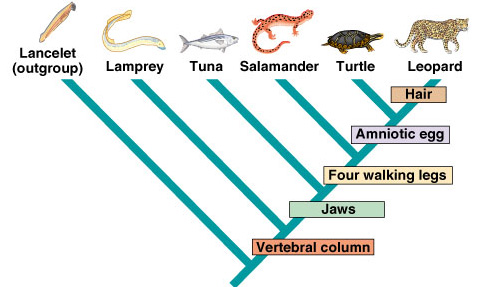
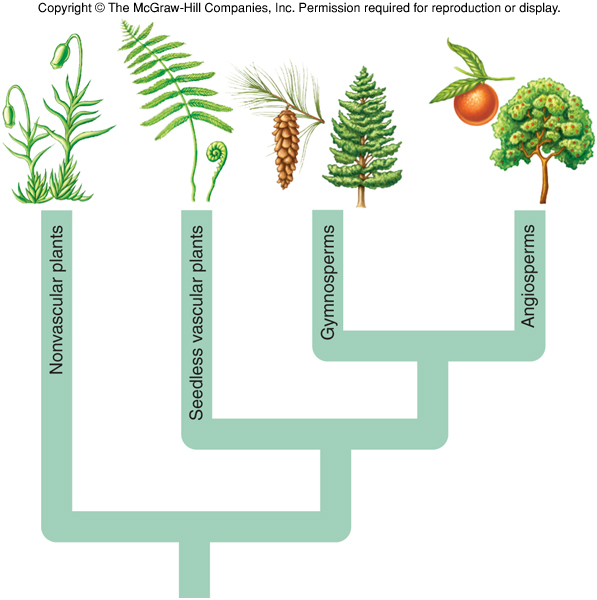
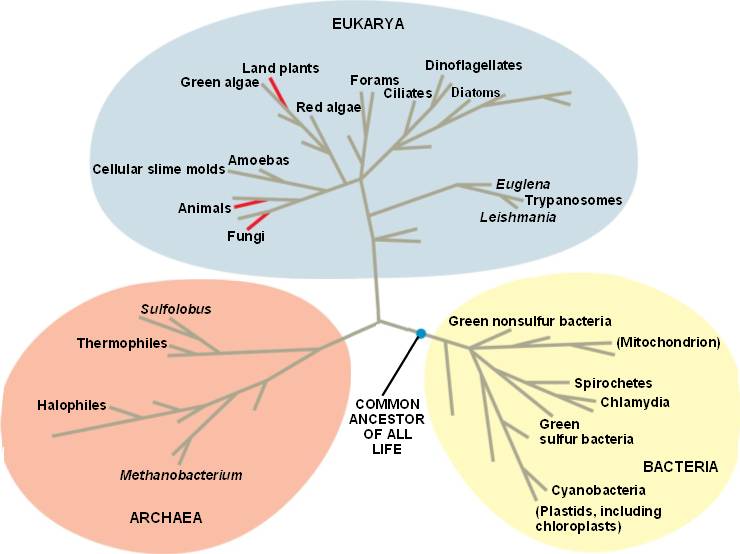
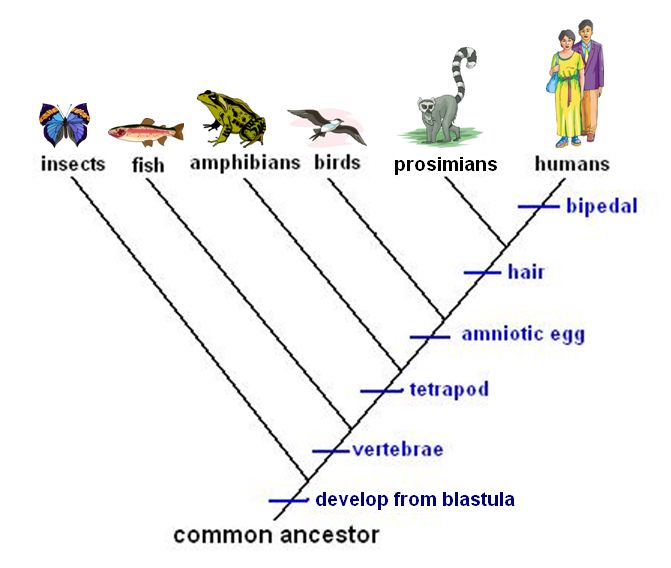
The second week was spent with chordates, including the vertebrates. We practiced making a cladogram - a chart showing the evolutionary relationship between groups of organisms based on shared derived characteristics.
If you missed out on the cladogram activity (or you just loved it and can't get enough) here is an activity on cladograms - what they are, what they show, how to build them, and a chance to make a simple one of your own.
Though our example cladogram was imperfect and relied on morphology as well, typically cladograms utilize embryological, developmental, or genetic shared derived characteristics because these more accurately reflect an evolutionary relationship.
And speaking of evolution...
Wk 10 Evolution 1 - History of Life on Earth
 This week begins our unit on evolution. Evolution is a fundamental concept in biology. The Theory of Evolution is often seen as the main overarching theme that ties all topics of Biology together. It includes Genetics, Population Biology, Anatomy and Physiology, Ecology, Animal Behavior, and Embryology, among others. The topic is controversial for some, and I encourage you to talk with your parents about it (and all the things we cover in class!), but our class will study the theory of evolution as it is currently understood and accepted by the scientific community at large. We will not cover the origins of life, as evolution does not address this directly, but rather the (inheritable) change in life.
- Evolution is the heritable (genetic) change in a population or species over generations.
- Species is a group of organisms which can successfully interbreed and whose offspring could also successfully interbreed.
- Population is a group of interacting individuals belonging to one species and living in the same geographic area.
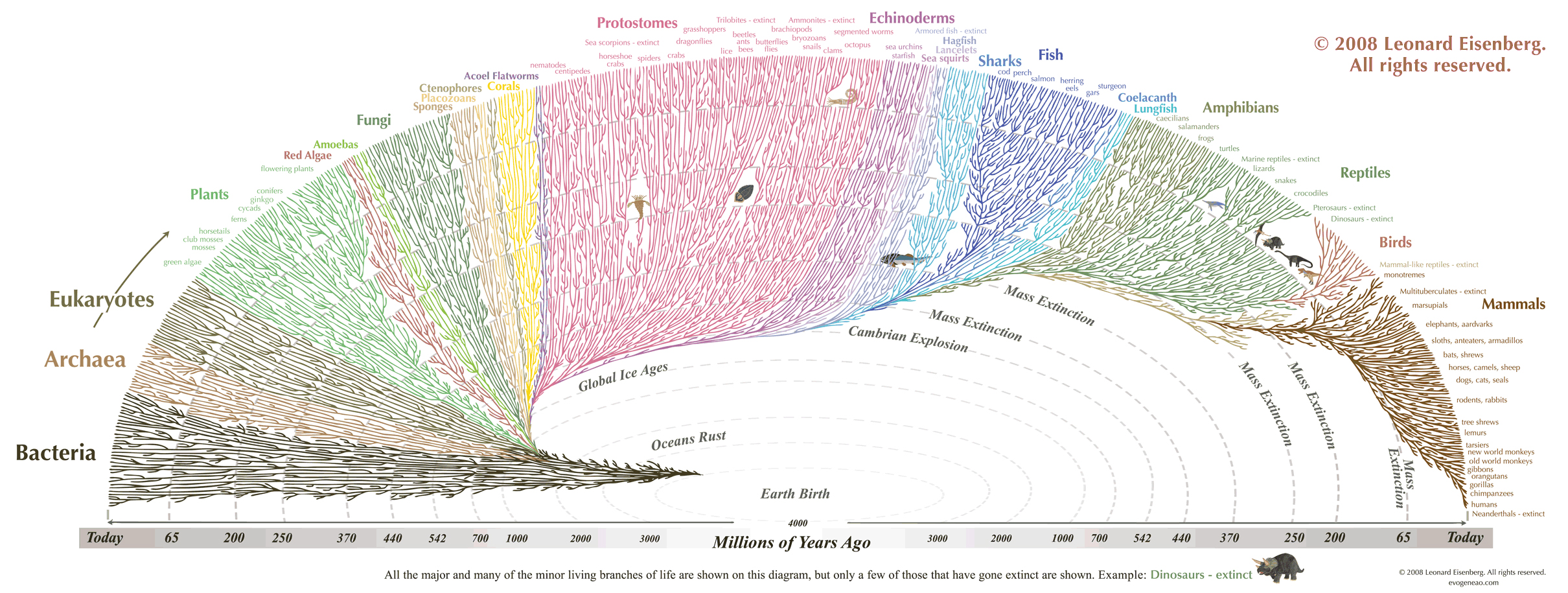
Before we get into the process of evolution (wk 11) we need to discuss the history and diversity of life on earth. We just spent six weeks covering taxonomy and diversity. The variety of living (extant) organisms on earth is quite amazing! And collectively, all current living organisms represent only a portion of the many, many organisms that have lived (and become extinct). The earth has existed for over 4.5 billion years, and evidence of life goes back over 3 billion years.
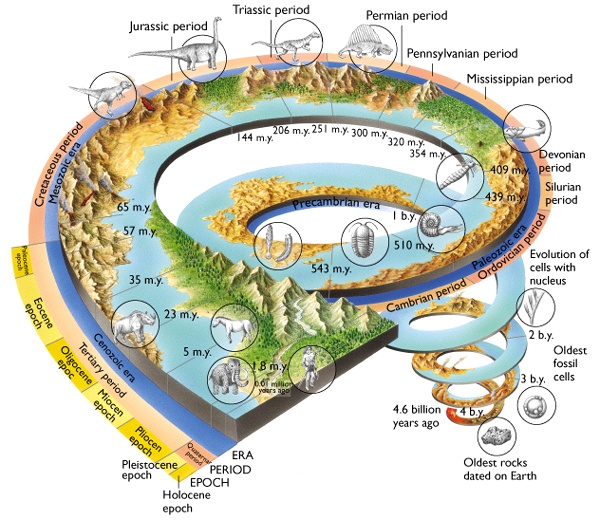
In that 3+ billion years of life on earth many species have evolved, and then become extinct, or evolved into new species. There is a complex interaction between organisms and their environment (by the way we call the study of this ecology), and as the earth changed, the life on it also changed. There have been major periods of heating and cooling, changes in the composition of the atmosphere, changes in the amount of available water, asteroids hitting the earth, periods of extensive volcanic activity, and the shifting of tectonic plates (and therefore land mass) on the surface of the earth. All of these environmental factors interacted in a dynamic (back and forth) way with the organisms on earth, creating periods of growth and diversification of life as well as extinction events.
Readings and Other Resources
Evolution 1
-History of Life on Earth
|
Ch. 20 A Story of
Luck
|
LOE 4.3
|
CK12 BC 5.1-5.9
|
CK12 LSC 4.12-4.14
|
Life
Has a History - both, choose Level 2, this is an interactive overview of
the topics covered in the three weeks of our evolution unit
History of the Earth in 5 1/2 Minutes
- both, this animated comic gives you an idea of the length of geologic time,
the age of the earth, the amazing events that have happened, and where modern
life fits in to that scale.
The History of Life on Earth -
scholar, CrashCourse, I know this is from their Ecology course, but it covers
this first week of evolution very well
|
So for this week make sure to:
- do the readings and other resources on the chart
- email me if you need anything for your astrobiology project
- keep working on your vocabulary lists
- read in Frankenstein/Jekyll & Hyde